External Volumes
An external volume is a read-only reference to a bucket or path in your own cloud object storage (such as AWS S3 or Google Cloud Storage), allowing Zilliz Cloud to access your data in place without copying or moving it.
This page explains how to create and delete external volumes via the web console and SDKs.
Considerations
-
A volume is restricted to your project’s cloud provider and region. For example, if your project is in AWS us-west-2, you can create volumes only in AWS us-west-2.
-
To use a volume with a cluster, the cluster must be in the same cloud provider and region as the volume.
-
To create and manage volumes, you need to be a Project Admin.
-
You cannot edit the configurations of a volume once it is created. If you want to change the volume settings, please create a new volume with the desired settings instead.
-
For external volumes, data stays in your bucket. Therefore, you need to manage data files in your cloud object storage rather than on the external volume.
-
Each organization can create up to 100 external volumes.
Before you start
Before creating an external volume, you need to integrate your AWS S3 bucket or Google GCS bucket. Note that the storage integration should be in the same cloud provider and region as the external volume you wish to create.
Create an external volume
-
Via SDKs
- Python
- Java
- Go
- Rust
- C++
- NodeJS
- cURL
python# Initiate a volume managerfrom pymilvus.bulk_writer.volume_manager import VolumeManagervolume_manager = VolumeManager(cloud_endpoint="https://api.cloud.zilliz.com",api_key="YOUR_API_KEY")volume_name = "external_volume"# Create an EXTERNAL volumevolume_manager.create_volume(project_id="proj-xxxxxxxxxxxxxxxxxxxxxxx",region_id="aws-us-west-2",volume_name=volume_name,volume_type="EXTERNAL",storage_integration_id="integ-xxxx",path="data/")print(f"\nVolume {volume_name} created")# Note: description is not supported by VolumeManager.create_volume as of pymilvus v3.0.2.javaimport io.milvus.bulkwriter.VolumeManager;import io.milvus.bulkwriter.VolumeManagerParam;import io.milvus.bulkwriter.request.volume.CreateVolumeRequest;String cloudEndpoint = "https://api.cloud.zilliz.com";String apiKey = "YOUR_API_KEY";String projectId = "proj-xxxxxxxxxxxxxxxxxxxxxxx";String regionId = "aws-us-west-2";String volumeName = "external_volume";VolumeManagerParam volumeManagerParam = VolumeManagerParam.newBuilder().withCloudEndpoint(cloudEndpoint).withApiKey(apiKey).build();VolumeManager volumeManager = new VolumeManager(volumeManagerParam);CreateVolumeRequest request = CreateVolumeRequest.builder().projectId(projectId).regionId(regionId).volumeName(volumeName).type("EXTERNAL").storageIntegrationId("integ-xxxx").path("data/").build();volumeManager.createVolume(request);System.out.printf("%nVolume %s created%n", volumeName);// Note: description is not supported by CreateVolumeRequest as of milvus-sdk-java-bulkwriter v3.0.10.go// Note: External Volume management with VolumeManager is not supported by milvus-sdk-go as of client/v3.0.0.rust// Note: External Volume management with VolumeManager is not supported in milvus-sdk-rust as of v3.0.2.c++// Note: External Volume management with VolumeManager is not supported in milvus-sdk-cpp as of v3.0.3.javascriptimport { VolumeManager } from "@zilliz/milvus2-sdk-node";const volumeManager = new VolumeManager({cloudEndpoint: "https://api.cloud.zilliz.com",apiKey: "YOUR_API_KEY"});const res = await volumeManager.createVolume({projectId: "proj-xxxxxxxxxxxxxxxxxxxxxxx",regionId: "aws-us-west-2",volumeName: "external_volume",type: "EXTERNAL",storageIntegrationId: "integ-xxxx",path: "data/"});console.log(res.data);// Note: description is not supported by VolumeCreateReq as of @zilliz/milvus2-sdk-node v3.0.6.bashexport BASE_URL="https://api.cloud.zilliz.com"export TOKEN="YOUR_API_KEY"curl --request POST \--url "${BASE_URL}/v2/volumes/create" \--header "Authorization: Bearer ${TOKEN}" \--header "Request-Timeout: 5" \--header "Content-Type: application/json" \-d '{"projectId": "proj-xxxxxxxxxxxxxxxxxxxxxxx","regionId": "aws-us-west-2","volumeName": "external_volume","type": "EXTERNAL","storageIntegrationId": "integ-xxxx","path": "data/","description": "A volume for storing collection data."}'# {# "code": 0,# "data": {# "volumeName": "external_volume"# }# }The following table describes the parameters.
Parameter Description projectIdThe ID of the project in which you want to create the volume. regionIdThe region of the volume to create must match the cloud provider and region of the target cluster you plan to import or migrate data into. volumeNameThe name of the volume to create must be unique across the organization, no longer than 64 characters, start with a letter or underscore, and contain only letters, digits, hyphens, and underscores. typeSet the parameter to EXTERNALto create an external volume. Defaults toMANAGED.storageIntegrationIdThe ID of the storage integration to reference. Required when type=EXTERNAL. The storage integration you select must belong to the same org and region as the external volume you want to create.pathThe storage path. Required when type=EXTERNAL.description(optional)The description of the volume to create. Up to 255 characters. -
Via web console
1In the left navigation, click on Volumes.
2On the volumes page, click on + Volume.
3Set the volume configurations.
The following table describes each parameter used when creating an external volume.
Parameter Description Name The volume name must be unique across the organization, no longer than 64 characters, start with a letter or underscore, and contain only letters, digits, hyphens, and underscores. Description This parameter is optional. Up to 255 characters. Volume Type Select "External" as the volume type. Cloud Provider & Region The volume cloud provider and region must match the cloud provider and region of the target cluster you plan to import or migrate data into. Storage Integration & Path Storage integration (AWS S3 bucket or Google GCS bucket) is the credential object that encapsulates the access configuration for your cloud storage.
Path is a pointer to where your data is placed. (Eg.folder/)4Click on Create.
List volumes
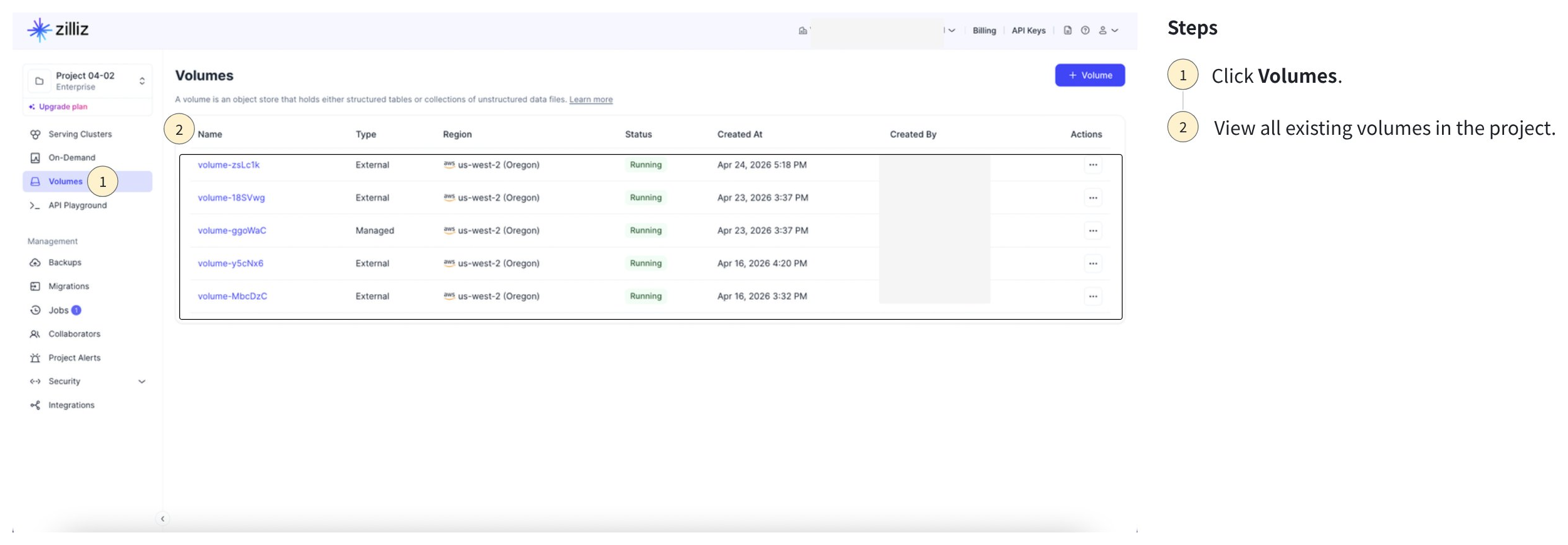
You can view all existing volumes in a project.
-
Via SDKs
- Python
- Java
- Go
- Rust
- C++
- NodeJS
- cURL
python# Initiate a volume managerfrom pymilvus.bulk_writer.volume_manager import VolumeManagervolume_manager = VolumeManager(cloud_endpoint="https://api.cloud.zilliz.com",api_key="YOUR_API_KEY")# List volumesvolume_list = volume_manager.list_volumes(project_id="proj-xxxxxxxxxxxxxxxxxxxxxxx",current_page=1,page_size=10)print("\nlistVolumes results:\n", volume_list.json()["data"])javaimport com.google.gson.Gson;import io.milvus.bulkwriter.VolumeManager;import io.milvus.bulkwriter.VolumeManagerParam;import io.milvus.bulkwriter.request.volume.ListVolumesRequest;import io.milvus.bulkwriter.response.volume.ListVolumesResponse;VolumeManagerParam volumeManagerParam = VolumeManagerParam.newBuilder().withCloudEndpoint("https://api.cloud.zilliz.com").withApiKey("YOUR_API_KEY").build();VolumeManager volumeManager = new VolumeManager(volumeManagerParam);ListVolumesRequest request = ListVolumesRequest.builder().projectId("proj-xxxxxxxxxxxxxxxxxxxxxxx").currentPage(1).pageSize(10).build();ListVolumesResponse response = volumeManager.listVolumes(request);System.out.println("listVolumes results: " + new Gson().toJson(response));go// Note: External Volume management with VolumeManager is not supported by milvus-sdk-go as of client/v3.0.0.rust// Note: External Volume management with VolumeManager is not supported in milvus-sdk-rust as of v3.0.2.c++// Note: External Volume management with VolumeManager is not supported in milvus-sdk-cpp as of v3.0.3.javascriptimport { VolumeManager } from "@zilliz/milvus2-sdk-node";const volumeManager = new VolumeManager({cloudEndpoint: "https://api.cloud.zilliz.com",apiKey: "YOUR_API_KEY"});const res = await volumeManager.listVolumes({projectId: "proj-xxxxxxxxxxxxxxxxxxxxxxx",currentPage: 1,pageSize: 10});console.log(res.data);bashexport BASE_URL="https://api.cloud.zilliz.com"export TOKEN="YOUR_API_KEY"curl --request GET \--url "${BASE_URL}/v2/volumes?projectId=proj-xxxxxxxxxxxxxxxxxxxxxxx¤tPage=1&pageSize=10" \--header "Authorization: Bearer ${TOKEN}" \--header "Content-Type: application/json" -
Via web console
Describe external volume
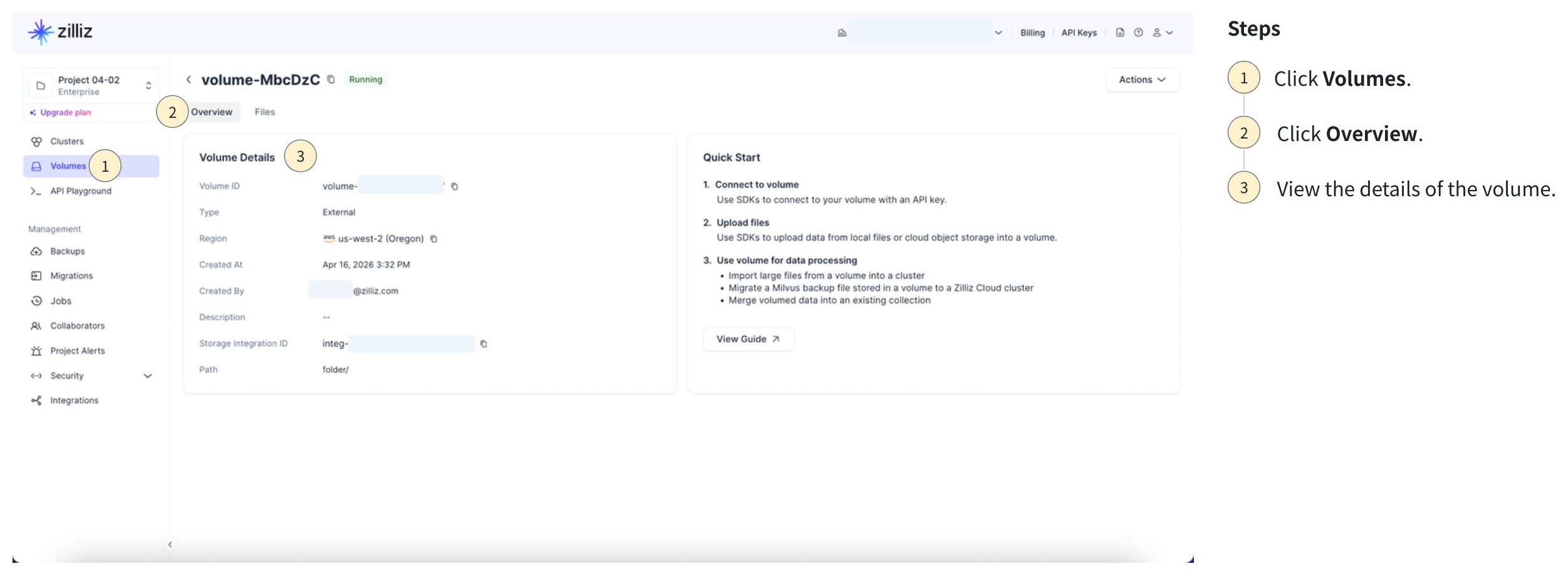
You can check the details of a specific volume.
-
Via SDKs
- Python
- Java
- Go
- Rust
- C++
- NodeJS
- cURL
python# Initiate a volume managerfrom pymilvus.bulk_writer.volume_manager import VolumeManagervolume_manager = VolumeManager(cloud_endpoint="https://api.cloud.zilliz.com",api_key="YOUR_API_KEY")volume_name = "external_volume"# Describe an external volumevolume_info = volume_manager.describe_volume(volume_name=volume_name)print("\ndescribeVolume result:\n", volume_info.json()["data"])javaimport com.google.gson.Gson;import io.milvus.bulkwriter.VolumeManager;import io.milvus.bulkwriter.VolumeManagerParam;import io.milvus.bulkwriter.request.volume.DescribeVolumeRequest;import io.milvus.bulkwriter.response.volume.VolumeInfo;String cloudEndpoint = "https://api.cloud.zilliz.com";String apiKey = "YOUR_API_KEY";String volumeName = "external_volume";VolumeManagerParam volumeManagerParam = VolumeManagerParam.newBuilder().withCloudEndpoint(cloudEndpoint).withApiKey(apiKey).build();VolumeManager volumeManager = new VolumeManager(volumeManagerParam);DescribeVolumeRequest request = DescribeVolumeRequest.builder().volumeName(volumeName).build();VolumeInfo volumeInfo = volumeManager.describeVolume(request);System.out.println("describeVolume result: " + new Gson().toJson(volumeInfo));go// Note: External Volume management with VolumeManager is not supported by milvus-sdk-go as of client/v3.0.0.rust// Note: External Volume management with VolumeManager is not supported in milvus-sdk-rust as of v3.0.2.c++// Note: External Volume management with VolumeManager is not supported in milvus-sdk-cpp as of v3.0.3.javascriptimport { VolumeManager } from "@zilliz/milvus2-sdk-node";const volumeManager = new VolumeManager({cloudEndpoint: "https://api.cloud.zilliz.com",apiKey: "YOUR_API_KEY"});const res = await volumeManager.describeVolume({volumeName: "external_volume"});console.log(res.data);bashexport BASE_URL="https://api.cloud.zilliz.com"export TOKEN="YOUR_API_KEY"export VOLUME_NAME="external_volume"curl --request GET \--url "${BASE_URL}/v2/volumes/${VOLUME_NAME}" \--header "Authorization: Bearer ${TOKEN}" \--header "Content-Type: application/json"# {# "code": 0,# "data": {# "volumeName": "external_volume",# "type": "EXTERNAL",# "regionId": "aws-us-west-2",# "storageIntegrationId": "integ-xxxx",# "path": "data/",# "status": "RUNNING",# "createTime": "2024-04-15T12:00:00Z"# }# } -
Via web console
Delete an external volume
You can delete an external volume at any time if it is no longer needed.
Deleting an external volume removes only the volume metadata from Zilliz Cloud; your data remains intact in your cloud object storage.
-
Via SDKs
- Python
- Java
- Go
- Rust
- C++
- NodeJS
- cURL
python# Initiate a volume managerfrom pymilvus.bulk_writer.volume_manager import VolumeManagervolume_manager = VolumeManager(cloud_endpoint="https://api.cloud.zilliz.com",api_key="YOUR_API_KEY")volume_name = "external_volume"# Delete an external volumevolume_manager.delete_volume(volume_name=volume_name)print(f"\nVolume {volume_name} deleted")javaimport io.milvus.bulkwriter.VolumeManager;import io.milvus.bulkwriter.VolumeManagerParam;import io.milvus.bulkwriter.request.volume.DeleteVolumeRequest;String cloudEndpoint = "https://api.cloud.zilliz.com";String apiKey = "YOUR_API_KEY";String volumeName = "external_volume";VolumeManagerParam volumeManagerParam = VolumeManagerParam.newBuilder().withCloudEndpoint(cloudEndpoint).withApiKey(apiKey).build();VolumeManager volumeManager = new VolumeManager(volumeManagerParam);DeleteVolumeRequest request = DeleteVolumeRequest.builder().volumeName(volumeName).build();volumeManager.deleteVolume(request);System.out.printf("%nVolume %s deleted%n", volumeName);go// Note: External Volume management with VolumeManager is not supported by milvus-sdk-go as of client/v3.0.0.rust// Note: External Volume management with VolumeManager is not supported in milvus-sdk-rust as of v3.0.2.c++// Note: External Volume management with VolumeManager is not supported in milvus-sdk-cpp as of v3.0.3.javascriptimport { VolumeManager } from "@zilliz/milvus2-sdk-node";const volumeManager = new VolumeManager({cloudEndpoint: "https://api.cloud.zilliz.com",apiKey: "YOUR_API_KEY"});const res = await volumeManager.deleteVolume({volumeName: "external_volume"});console.log(res.data);bashexport BASE_URL="https://api.cloud.zilliz.com"export TOKEN="YOUR_API_KEY"export VOLUME_NAME="external_volume"curl --request DELETE \--url "${BASE_URL}/v2/volumes/${VOLUME_NAME}" \--header "Authorization: Bearer ${TOKEN}" \--header "Content-Type: application/json"# {# "code": 0,# "data": {# "volumeName": "external_volume"# }# } -
Via web console
1In the left navigation, click on Volumes.
2Click on ... in the Actions column, and then select Delete.
3Enter the volume name and click on Delete.
Billing
Creating and using an external volume incurs no Zilliz Cloud charges. No payment method is required.
However, your cloud provider may charge data request fees when Zilliz Cloud reads from your bucket during import or migration. For details, see Amazon S3 Pricing or Google Cloud Storage Pricing.
FAQs
What happens to my volumes if my organization is frozen due to overdue invoices?
If an organization is frozen, all managed Volumes — both free trial and pay-as-you-go — and all files stored in them are deleted and cannot be restored. External volumes are also frozen and cannot be used for new operations, but your data in your own bucket is not affected.
To continue using volumes, first settle all outstanding invoices.
What is the difference between an external volume and importing directly from external storage?
Both allow you to import data from your own S3 or GCS bucket. The key differences are:
-
External volume requires you to integrate an AWS S3 bucket, a Google Cloud Storage bucket, or a Microsoft Azure blob storage container with Zilliz Cloud for credential management. Credentials are set up once and reused across multiple volumes and operations. Data engineers do not need direct access to cloud storage keys.
-
Direct external storage import requires you to provide credentials (access key and secret key) with each import request. This is simpler for one-time imports but does not offer credential separation or reusability.
Can I modify the storage integration or path of an external volume after creation?
No. The storage integration and path cannot be changed after an external volume is created. To use a different storage integration or path, create a new external volume.
Can I delete an external volume that is referenced by an active job or external collection?
No. Deletion is blocked if downstream external collections or active jobs reference the volume.
Will I be charged for data transfer fees when I use an external volume?
No. External volumes must be in the same cloud provider and region as your cluster. Since all data access occurs within the same region, no cross-region data transfer fees are incurred on Zilliz Cloud.
What do the volume statuses mean?
The following table lists the possible volume statuses.
Status | Description |
|---|---|
Available | The volume is active and usable. |
Frozen | The organization is frozen due to overdue invoices. The volume cannot be used for new operations. Please pay your bill to continue using volumes. |
Error | The storage integration validation failed. Check the configuration and retry. Application storage integrations are as follows: |