Boost Ranker
ベクトル距離に基づく意味的類似度だけに依存するのではなく、Boost Ranker を使うことで検索結果に意図した影響を与えられます。メタデータフィルタリングを用いて検索結果を素早く調整したい場合に最適です。
検索リクエストに Boost Ranker 関数が含まれる場合、Milvus は関数内の任意のフィルタリング条件を使用して検索結果の候補から一致するものを特定し、指定された重みを適用してそれらのスコアをブーストすることで、最終結果における一致したエンティティの順位を上げ下げします。
Boost Ranker の使用場面
クロスエンコーダーモデルや融合アルゴリズムに依存する他のランカーとは異なり、Boost Ranker はメタデータに基づく任意のルールをランキングプロセスに直接組み込むため、以下のシナリオにより適しています。
ユースケース | 例 | Boost Ranker が効果的な理由 |
|---|---|---|
ビジネス主導のコンテンツ優先順位付け |
| インデックスの再構築やベクトル埋め込みモデルの変更といった時間のかかる操作を必要とせず、リアルタイムで任意のメタデータフィルターを適用することで、検索結果内の特定のアイテムを即座に昇格または降格できます。この仕組みにより、変化するビジネス要件に容易に適応できる柔軟で動的な検索ランキングを実現できます。 |
戦略的なコンテンツの降格 |
|
複数の Boost Ranker を組み合わせて、より動的で堅牢な重みベースのランキング戦略を実装することもできます。
Boost Ranker の仕組み
次の図は、Boost Ranker の主なワークフローを示しています。
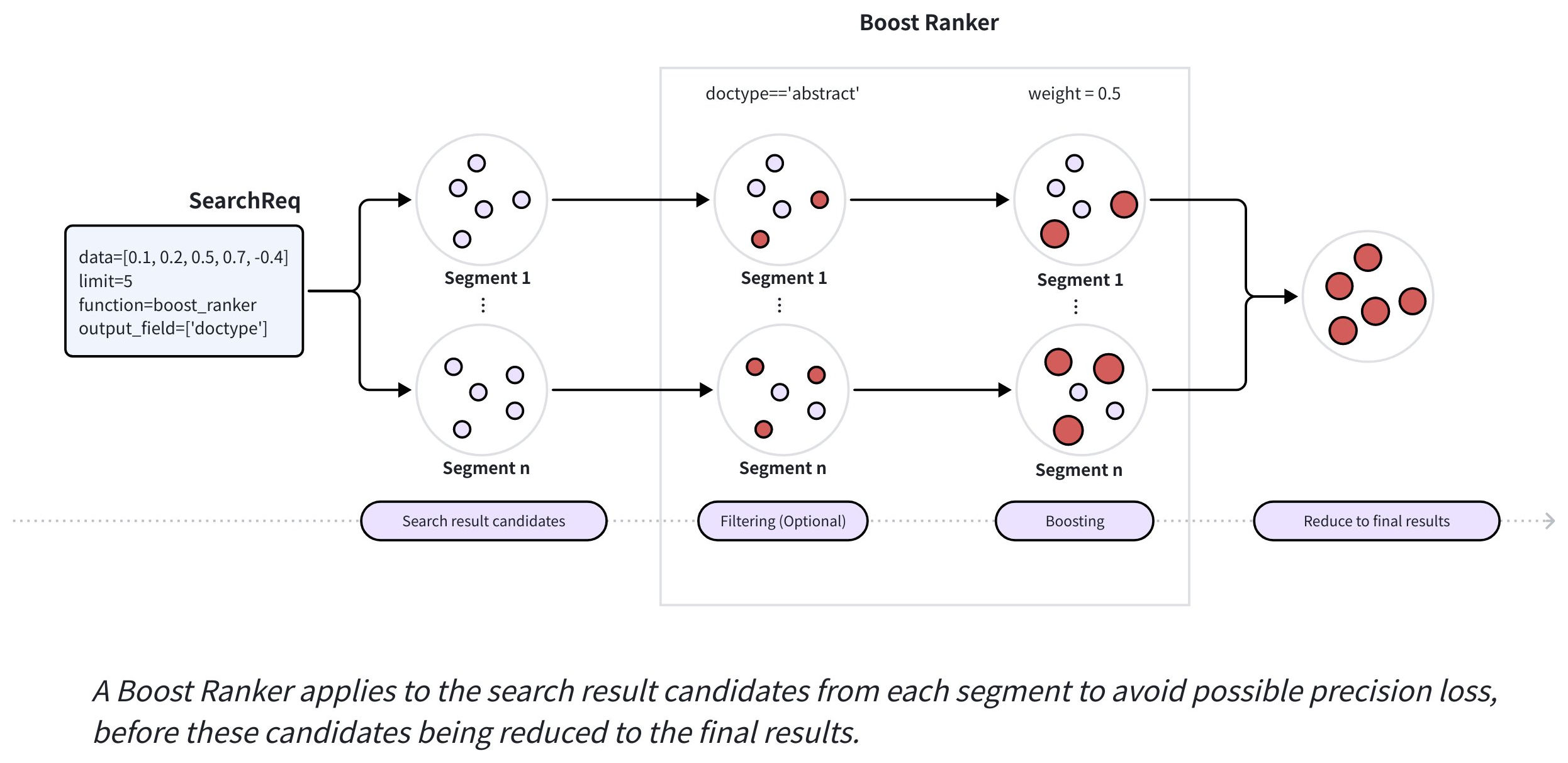
データを挿入すると、Zilliz Cloud はそれをセグメント全体に分散します。検索時には、各セグメントが候補セットを返し、Zilliz Cloud がすべてのセグメントの候補をランク付けして最終結果を生成します。検索リクエストに Boost Ranker が含まれる場合、Zilliz Cloud は潜在的な精度低下を防ぎ再現率を向上させるため、各セグメントの候補結果に Boost Ranker を適用します。
結果を確定する前に、Milvus は Boost Ranker を使用してこれらの候補を次のように処理します。
-
Boost Ranker で指定された任意のフィルタリング式を適用し、その式に一致するエンティティを特定します。
-
Boost Ranker で指定された重みを適用し、特定されたエンティティのスコアをブーストします。
Boost Ranker はマルチベクトルハイブリッド検索では使用できません。
Boost Ranker の例
以下の例では、最も関連性の高い上位 5 つのエンティティを返し、abstract ドキュメントタイプを持つエンティティのスコアに重みを加える単一ベクトル検索における Boost Ranker の使用方法を示します。
-
セグメント内の検索結果候補を収集します。
以下の表では、Milvus がエンティティを 2 つのセグメント(0001 と 0002)に分散し、各セグメントが 5 つの候補を返すことを想定しています。
ID DocType スコア ランク セグメント 117 abstract 0.344 1 0001 89 abstract 0.456 2 0001 257 body 0.578 3 0001 358 title 0.788 4 0001 168 body 0.899 5 0001 46 body 0.189 1 0002 48 body 0265 2 0002 561 abstract 0.366 3 0002 344 abstract 0.444 4 0002 276 abstract 0.845 5 0002 -
Boost Ranker で指定されたフィルタリング式を適用します(
doctype='abstract')。以下の表の
DocTypeフィールドに示されるように、Milvus はdoctypeがabstractに設定されているすべてのエンティティを以降の処理対象としてマークします。ID DocType スコア ランク セグメント 117 abstract 0.344 1 0001 89 abstract 0.456 2 0001 257 body 0.578 3 0001 358 title 0.788 4 0001 168 body 0.899 5 0001 46 body 0.189 1 0002 48 body 0265 2 0002 561 abstract 0.366 3 0002 344 abstract 0.444 4 0002 276 abstract 0.845 5 0002 -
Boost Ranker で指定された重みを適用します(
weight=0.5)。前のステップで特定されたすべてのエンティティには、Boost Ranker で指定された重みが乗算され、その結果、ランクが変化します。
ID DocType スコア 重み付きスコア
(= スコア × 重み)ランク セグメント 117 abstract 0.344 0.172 1 0001 89 abstract 0.456 0.228 2 0001 257 body 0.578 0.578 3 0001 358 title 0.788 0.788 4 0001 168 body 0.899 0.899 5 0001 561 abstract 0.366 0.183 1 0002 46 body 0.189 0.189 2 0002 344 abstract 0.444 0.222 3 0002 48 body 0.265 0.265 4 0002 276 abstract 0.845 0.423 5 0002 Notes重みは自由に選択できる浮動小数点数である必要があります。上記の例のようにスコアが小さいほど関連性が高い場合は、1 より小さい重みを使用します。それ以外の場合は、1 より大きい重みを使用します。
-
重み付きスコアに基づいてすべてのセグメントの候補を集約し、最終結果を確定します。
ID DocType スコア 重み付きスコア ランク セグメント 117 abstract 0.344 0.172 1 0001 561 abstract 0.366 0.183 2 0002 46 body 0.189 0.189 3 0002 344 abstract 0.444 0.222 4 0002 89 abstract 0.456 0.228 5 0001
Boost Ranker の使用方法
このセクションでは、Boost Ranker を使用して単一ベクトル検索の結果に影響を与える方法の例を示します。
Boost Ranker の作成
検索リクエストの reranker として Boost Ranker を渡す前に、以下のように Boost Ranker を再ランキング関数として適切に定義しておく必要があります。
- Python
- Java
- Go
- Rust
- C++
- NodeJS
- cURL
from pymilvus import Function, FunctionType

rerank = Function(
    name="boost",
    input_field_names=[], # Must be an empty list
    function_type=FunctionType.RERANK,
    params={
        "reranker": "boost",
        "filter": "doctype == 'abstract'",
        "random_score": {
            "seed": 126,
            "field": "id"
        },
        "weight": 0.5
    }
)
import io.milvus.v2.service.vector.request.ranker.BoostRanker;

BoostRanker rerank = BoostRanker.builder()
        .name("boost")
        .filter("doctype == \"abstract\"")
        .weight(0.5f)
        .randomScoreField("id")
        .randomScoreSeed(126L)
        .build();
import "github.com/milvus-io/milvus/client/v3/entity"

rerank := entity.NewFunction().
    WithName("boost").
    WithType(entity.FunctionTypeRerank).
    WithParam("reranker", "boost").
    WithParam("filter", "doctype == 'abstract'").
    WithParam("random_score", "{\"seed\": 126, \"field\": \"id\"}").
    WithParam("weight", "0.5")
use milvus::v2::prelude::*;

let rerank = Function::new()
    .name("boost")
    .function_type(FunctionType::Rerank)
    .param("reranker", "boost")
    .param("filter", "doctype == 'abstract'")
    .param("random_score", "{\"seed\": 126, \"field\": \"id\"}")
    .param("weight", "0.5");
auto rerank = std::make_shared<milvus::BoostRerank>("boost");
rerank->SetFilter("doctype == 'abstract'");
rerank->SetWeight(0.5);
// Note: SetRandomScoreField()/SetRandomScoreSeed() are not usable as of
// milvus-sdk-cpp v3.0.3 - the SDK sends the seed as a string, which the
// server rejects (a numeric seed is required).
import {FunctionType} from '@zilliz/milvus2-sdk-node';

const rerank = {
  name: "boost",
  input_field_names: [],
  type: FunctionType.RERANK,
  params: {
    reranker: "boost",
    filter: "doctype == 'abstract'",
    random_score: {
      seed: 126,
      field: "id",
    },
    weight: 0.5,
  },
};
# restful
export RANKER='{
    "name": "boost",
    "type": "Rerank",
    "inputFieldNames": [],
    "outputFieldNames": [],
    "params": {
        "reranker": "boost",
        "filter": "doctype == '\''abstract'\''",
        "random_score": {"seed": 126, "field": "id"},
        "weight": 0.5
    }
}'
パラメーター | 必須? | 説明 | 値/Example |
|---|---|---|---|
| はい | この Function の一意の識別子 |
|
| はい | 関数を適用するベクトルフィールドのリスト(Boost Ranker の場合は空にする必要があります) |
|
| はい | 呼び出す Function のタイプ。再ランキング戦略を指定するには |
|
| はい | reranker のタイプを指定します。 Boost Ranker を使用するには |
|
| はい | 生の検索結果において、一致するエンティティのスコアに乗算される重みを指定します。 値は浮動小数点数である必要があります。
|
|
| いいえ | 検索結果のエンティティの中から一致するものを特定するために使用するフィルター式を指定します。フィルタリングの説明 に記載されている任意の有効な基本フィルター式を使用できます。 注: 使用できるのは |
|
| いいえ |
同じシードとフィールド値を使用して生成ごとの一貫性を確保するため、 |
|
単一の Boost Ranker を使用した検索
Boost Ranker 関数の準備ができたら、検索リクエストでそれを参照できます。以下の例では、id、vector、doctype の各フィールド(vector はベクトルフィールド)を持つコレクションをすでに作成していることを前提としています。
- Python
- Java
- Go
- Rust
- C++
- NodeJS
- cURL
from pymilvus import MilvusClient

# Connect to the Milvus server
client = MilvusClient(
    uri="YOUR_CLUSTER_ENDPOINT",
    token="YOUR_CLUSTER_TOKEN"
)

# Assume you have a collection set up

# Conduct a similarity search using the created ranker
client.search(
    collection_name="my_collection",
    data=[[-0.619954382375778, 0.4479436794798608, -0.17493894838751745, -0.4248030059917294, -0.8648452746018911]],
    anns_field="vector",
    params={},
    output_fields=["doctype"],
    ranker=rerank
)
import io.milvus.v2.client.ConnectConfig;
import io.milvus.v2.client.MilvusClientV2;
import io.milvus.v2.service.vector.request.FunctionScore;
import io.milvus.v2.service.vector.request.SearchReq;
import io.milvus.v2.service.vector.request.data.FloatVec;
import io.milvus.v2.service.vector.response.SearchResp;
import java.util.*;

MilvusClientV2 client = new MilvusClientV2(ConnectConfig.builder()
        .uri("YOUR_CLUSTER_ENDPOINT")
        .token("YOUR_CLUSTER_TOKEN")
        .build());

SearchResp searchResp = client.search(SearchReq.builder()
        .collectionName("my_collection")
        .data(Collections.singletonList(new FloatVec(new float[]{-0.619954f, 0.447943f, -0.174938f, -0.424803f, -0.864845f})))
        .annsField("vector")
        .outputFields(Collections.singletonList("doctype"))
        .topK(10)
        .functionScore(FunctionScore.builder()
                .addFunction(rerank)
                .build())
        .build());
import (
    "context"
    "fmt"

    "github.com/milvus-io/milvus/client/v3/entity"
    "github.com/milvus-io/milvus/client/v3/milvusclient"
)

resultSet, err := client.Search(ctx, milvusclient.NewSearchOption("my_collection", 10, []entity.Vector{
    entity.FloatVector{-0.619954382375778, 0.4479436794798608, -0.17493894838751745, -0.4248030059917294, -0.8648452746018911},
}).
    WithANNSField("vector").
    WithOutputFields("doctype").
    WithFunctionScore(entity.NewFunctionScore().AddFunction(rerank)))
if err != nil {
    fmt.Println(err.Error())
    // handle error
}
fmt.Println(resultSet)
use milvus::v2::prelude::*;

let client = ClientV2::new(&ConnectConfig::new().uri("YOUR_CLUSTER_ENDPOINT").token("YOUR_CLUSTER_TOKEN")).await?;

let response = client
    .search(
        SearchRequest::builder()
            .collection_name("my_collection")
            .vector_field("vector")
            .vectors(SearchVectors::Float(vec![vec![-0.619954382375778, 0.4479436794798608, -0.17493894838751745, -0.4248030059917294, -0.8648452746018911]]))
            .output_fields(["doctype"])
            .limit(10)
            .rerank(FunctionScore::new().add_function(rerank.clone()))
            .build()?,
    )
    .await?;
println!("{:?}", response);
#include "milvus/MilvusClientV2.h"
#include <iostream>
#include <vector>

auto client = milvus::MilvusClientV2::Create();

milvus::ConnectParam connect_param{"YOUR_CLUSTER_ENDPOINT", "YOUR_CLUSTER_TOKEN"};
auto status = client->Connect(connect_param);
if (!status.IsOk()) {
    std::cout << status.Message() << std::endl;
}

auto function_score = std::make_shared<milvus::FunctionScore>();
function_score->AddFunction(rerank);

std::vector<float> query_vector = {-0.619954382375778, 0.4479436794798608, -0.17493894838751745, -0.4248030059917294, -0.8648452746018911};
auto request = milvus::SearchRequest()
                   .WithCollectionName("my_collection")
                   .WithAnnsField("vector")
                   .WithLimit(10)
                   .WithRerank(function_score)
                   .AddOutputField("doctype")
                   .AddFloatVector(query_vector);

milvus::SearchResponse response;
status = client->Search(request, response);
if (!status.IsOk()) {
    std::cout << status.Message() << std::endl;
}
import { MilvusClient } from '@zilliz/milvus2-sdk-node';

// Connect to the Milvus server
const client = new MilvusClient({
  address: 'YOUR_CLUSTER_ENDPOINT',
  token: 'YOUR_CLUSTER_TOKEN'
});

// Assume you have a collection set up

// Conduct a similarity search
const searchResults = await client.search({
  collection_name: 'my_collection',
  data: [-0.619954382375778, 0.4479436794798608, -0.17493894838751745, -0.4248030059917294, -0.8648452746018911],
  anns_field: 'vector',
  output_fields: ['doctype'],
  limit: 10,
  rerank: rerank,
});

console.log('Search results:', searchResults);
# restful
export MILVUS_HOST="YOUR_CLUSTER_ENDPOINT"
export MILVUS_TOKEN="YOUR_CLUSTER_TOKEN"
curl -X POST "http://${MILVUS_HOST}/v2/vectordb/entities/search" \
  -H "Content-Type: application/json" \
  -H "Request-Timeout: 10" \
  -H "Authorization: Bearer ${MILVUS_TOKEN}" \
  -d '{
    "collectionName": "my_collection",
    "data": [[-0.619954382375778, 0.4479436794798608, -0.17493894838751745, -0.4248030059917294, -0.8648452746018911]],
    "annsField": "vector",
    "limit": 10,
    "outputFields": ["doctype"],
    "functionScore": {
        "functions": [
            {
                "name": "boost",
                "type": "Rerank",
                "inputFieldNames": [],
                "outputFieldNames": [],
                "params": {
                    "reranker": "boost",
                    "filter": "doctype == '\''abstract'\''",
                    "random_score": {"seed": 126, "field": "id"},
                    "weight": 0.5
                }
            }
        ]
    }
  }'
複数の Boost Ranker を使用した検索
1 回の検索で複数の Boost Ranker を組み合わせて、検索結果に影響を与えることができます。そのためには、複数の Boost Ranker を作成し、それらを FunctionScore インスタンスで参照し、その FunctionScore インスタンスを検索リクエストの ranker として使用します。
以下の例では、0.8 から 1.2 の間の重みを適用して、特定されたすべてのエンティティのスコアを変更する方法を示します。
- Python
- Java
- Go
- Rust
- C++
- NodeJS
- cURL
from pymilvus import MilvusClient, Function, FunctionType, FunctionScore

# Create a Boost Ranker with a fixed weight
fix_weight_ranker = Function(
    name="boost",
    input_field_names=[], # Must be an empty list
    function_type=FunctionType.RERANK,
    params={
        "reranker": "boost",
        "weight": 0.8
    }
)

# Create a Boost Ranker with a randomly generated weight between 0 and 0.4
random_weight_ranker = Function(
    name="boost",
    input_field_names=[], # Must be an empty list
    function_type=FunctionType.RERANK,
    params={
        "reranker": "boost",
        "random_score": {
            "seed": 126,
        },
        "weight": 0.4
    }
)

# Create a Function Score
ranker = FunctionScore(
    functions=[
        fix_weight_ranker,
        random_weight_ranker
    ],
    params={
        "boost_mode": "Multiply",
        "function_mode": "Sum"
    }
)

# Conduct a similarity search using the created Function Score
client.search(
    collection_name="my_collection",
    data=[[-0.619954382375778, 0.4479436794798608, -0.17493894838751745, -0.4248030059917294, -0.8648452746018911]],
    anns_field="vector",
    params={},
    output_fields=["doctype"],
    ranker=ranker
)
import io.milvus.common.clientenum.FunctionType;
import io.milvus.v2.service.collection.request.CreateCollectionReq;
import io.milvus.v2.service.vector.request.FunctionScore;
import io.milvus.v2.service.vector.request.SearchReq;
import io.milvus.v2.service.vector.request.data.FloatVec;
import io.milvus.v2.service.vector.response.SearchResp;
import java.util.*;

CreateCollectionReq.Function fixWeightRanker = CreateCollectionReq.Function.builder()
        .functionType(FunctionType.RERANK)
        .name("boost")
        .param("reranker", "boost")
        .param("weight", "0.8")
        .build();

CreateCollectionReq.Function randomWeightRanker = CreateCollectionReq.Function.builder()
        .functionType(FunctionType.RERANK)
        .name("boost")
        .param("reranker", "boost")
        .param("weight", "0.4")
        .param("random_score", "{\"seed\": 126}")
        .build();

Map<String, String> params = new HashMap<>();
params.put("boost_mode", "Multiply");
params.put("function_mode", "Sum");

FunctionScore ranker = FunctionScore.builder()
        .addFunction(fixWeightRanker)
        .addFunction(randomWeightRanker)
        .params(params)
        .build();

SearchResp searchResp = client.search(SearchReq.builder()
        .collectionName("my_collection")
        .data(Collections.singletonList(new FloatVec(new float[]{-0.619954382375778f, 0.4479436794798608f, -0.17493894838751745f, -0.4248030059917294f, -0.8648452746018911f})))
        .annsField("vector")
        .outputFields(Collections.singletonList("doctype"))
        .topK(10)
        .functionScore(ranker)
        .build());
import (
    "context"
    "fmt"

    "github.com/milvus-io/milvus/client/v3/entity"
    "github.com/milvus-io/milvus/client/v3/milvusclient"
)

fixWeightRanker := entity.NewFunction().
    WithName("boost").
    WithType(entity.FunctionTypeRerank).
    WithParam("reranker", "boost").
    WithParam("weight", "0.8")

randomWeightRanker := entity.NewFunction().
    WithName("boost").
    WithType(entity.FunctionTypeRerank).
    WithParam("reranker", "boost").
    WithParam("random_score", "{\"seed\": 126}").
    WithParam("weight", "0.4")

ranker := entity.NewFunctionScore().
    AddFunction(fixWeightRanker).
    AddFunction(randomWeightRanker).
    WithParam("boost_mode", "Multiply").
    WithParam("function_mode", "Sum")

resultSet, err := client.Search(ctx, milvusclient.NewSearchOption("my_collection", 10, []entity.Vector{entity.FloatVector{-0.619954382375778, 0.4479436794798608, -0.17493894838751745, -0.4248030059917294, -0.8648452746018911}}).
    WithANNSField("vector").
    WithOutputFields("doctype").
    WithFunctionScore(ranker))
if err != nil {
    fmt.Println(err.Error())
    // handle error
}
fmt.Println(resultSet)
use milvus::v2::prelude::*;
use std::collections::HashMap;

let client = ClientV2::new(&ConnectConfig::new().uri("YOUR_CLUSTER_ENDPOINT").token("YOUR_CLUSTER_TOKEN")).await?;

let fix_weight_ranker = Function::new()
    .name("boost")
    .function_type(FunctionType::Rerank)
    .param("reranker", "boost")
    .param("weight", "0.8");

let random_weight_ranker = Function::new()
    .name("boost")
    .function_type(FunctionType::Rerank)
    .param("reranker", "boost")
    .param("random_score", "{\"seed\": 126}")
    .param("weight", "0.4");

let function_score = FunctionScore::new()
    .add_function(fix_weight_ranker)
    .add_function(random_weight_ranker)
    .params(HashMap::from([
        ("boost_mode".to_string(), "Multiply".into()),
        ("function_mode".to_string(), "Sum".into()),
    ]));

let response = client
    .search(
        SearchRequest::builder()
            .collection_name("my_collection")
            .vector_field("vector")
            .vectors(SearchVectors::Float(vec![vec![-0.619954382375778, 0.4479436794798608, -0.17493894838751745, -0.4248030059917294, -0.8648452746018911]]))
            .output_fields(["doctype"])
            .limit(10)
            .rerank(function_score)
            .build()?,
    )
    .await?;
println!("{:?}", response);
#include <iostream>
#include <vector>

auto fix_weight_ranker = std::make_shared<milvus::BoostRerank>("boost");
fix_weight_ranker->SetWeight(0.8);

auto random_weight_ranker = std::make_shared<milvus::BoostRerank>("boost");
random_weight_ranker->SetWeight(0.4);
// Note: SetRandomScoreSeed() is not usable as of milvus-sdk-cpp v3.0.3 —
// the SDK sends the seed as a string, which the server rejects.

auto function_score = std::make_shared<milvus::FunctionScore>();
function_score->AddFunction(fix_weight_ranker);
function_score->AddFunction(random_weight_ranker);

std::vector<float> query_vector = {-0.619954382375778, 0.4479436794798608, -0.17493894838751745, -0.4248030059917294, -0.8648452746018911};
auto request = milvus::SearchRequest()
                   .WithCollectionName("my_collection")
                   .WithAnnsField("vector")
                   .WithLimit(10)
                   .WithRerank(function_score)
                   .AddOutputField("doctype")
                   .AddFloatVector(query_vector);

milvus::SearchResponse response;
auto status = client->Search(request, response);
if (!status.IsOk()) {
    std::cout << status.Message() << std::endl;
}
import {FunctionType} from '@zilliz/milvus2-sdk-node';

const fix_weight_ranker = {
  name: "boost",
  input_field_names: [],
  type: FunctionType.RERANK,
  params: {
    reranker: "boost",
    weight: 0.8,
  },
};

const random_weight_ranker = {
  name: "boost",
  input_field_names: [],
  type: FunctionType.RERANK,
  params: {
    reranker: "boost",
    random_score: {
      seed: 126,
    },
    weight: 0.4,
  },
};

const ranker = {
  functions: [fix_weight_ranker, random_weight_ranker],
  params: {
    boost_mode: "Multiply",
    function_mode: "Sum",
  },
};

await client.search({
  collection_name: "my_collection",
  data: [[-0.619954382375778, 0.4479436794798608, -0.17493894838751745, -0.4248030059917294, -0.8648452746018911]],
  anns_field: "vector",
  params: {},
  output_fields: ["doctype"],
  limit: 10,
  rerank: ranker
});
# restful
export MILVUS_HOST="YOUR_CLUSTER_ENDPOINT"
export MILVUS_TOKEN="YOUR_CLUSTER_TOKEN"
curl -X POST "http://${MILVUS_HOST}/v2/vectordb/entities/search" \
  -H "Content-Type: application/json" \
  -H "Request-Timeout: 10" \
  -H "Authorization: Bearer ${MILVUS_TOKEN}" \
  -d '{
    "collectionName": "my_collection",
    "data": [[-0.619954382375778, 0.4479436794798608, -0.17493894838751745, -0.4248030059917294, -0.8648452746018911]],
    "annsField": "vector",
    "limit": 10,
    "outputFields": ["doctype"],
    "functionScore": {
        "functions": [
            {
                "name": "boost",
                "type": "Rerank",
                "inputFieldNames": [],
                "outputFieldNames": [],
                "params": {
                    "reranker": "boost",
                    "weight": 0.8
                }
            },
            {
                "name": "boost",
                "type": "Rerank",
                "inputFieldNames": [],
                "outputFieldNames": [],
                "params": {
                    "reranker": "boost",
                    "random_score": {"seed": 126},
                    "weight": 0.4
                }
            }
        ],
        "params": {
            "boost_mode": "Multiply",
            "function_mode": "Sum"
        }
    }
  }'
具体的には、2 つの Boost Ranker があります。一方は検出されたすべてのエンティティに固定の重みを適用し、もう一方はそれらにランダムな重みを割り当てます。次に、これら 2 つの ranker を FunctionScore で参照します。この FunctionScore では、重みが検出されたエンティティのスコアにどのように影響するかも定義します。
以下の表に、FunctionScore インスタンスの作成に必要なパラメーターを示します。
パラメーター | 必須? | 説明 | 値/Example |
|---|---|---|---|
| はい | 対象のランカーの名前をリストで指定します。 |
|
| いいえ | 指定した重みが、一致するエンティティのスコアにどのように影響するかを指定します。 使用可能な値は次のとおりです。
|
|
| いいえ | 各 Boost Ranker からの重み付けされた値がどのように処理されるかを指定します。 使用可能な値は次のとおりです。
|
|