サービングクラスターのクイックスタート
サービングクラスターは、リアルタイムの本番サービング向けにコンピューティングとストレージの両方を兼ね備えた自己完結型のサーバーです。Extract-Transform-Load(ETL)パイプラインを通じてデータをクレンジングしたら、そのデータをサービングクラスターにインポートすることで、大幅なパフォーマンス向上を実現できます。
事前準備
Zilliz Cloud は、Bring-Your-Own-Cloud(BYOC)ソリューションを提供しており、組織がアプリケーションとデータを Zilliz Cloud のインフラストラクチャ上ではなく、自社のクラウドアカウントでホストできるようにします。BYOC ソリューションの詳細については、BYOC の概要 を参照してください。
次の図は、BYOC ソリューションを使い始めるための手順を示しています。
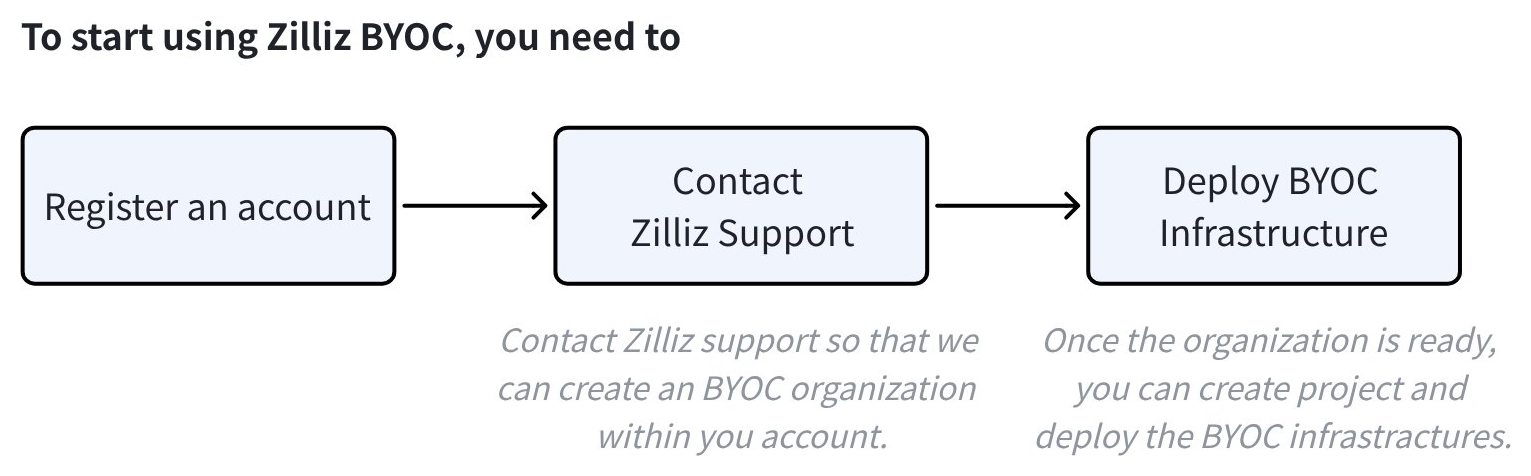
このクイックスタートを進める前に、以下の条件を満たしていることを確認してください。
-
Zilliz Cloud のアカウントを登録していること。
手順については、Zilliz Cloud への登録 を参照してください。
-
Zilliz Cloud の営業担当者に連絡し、アカウント情報を提供していること。
NotesZilliz BYOC は現在 General Availability で提供されています。アクセスと実装の詳細については、Zilliz Cloud の営業担当者 にお問い合わせください。
-
BYOC 組織でプロジェクトを作成し、そのプロジェクトのデータプレーンインフラストラクチャをデプロイしていること。
Zilliz BYOC はお客様の Virtual Private Cloud(VPC)内で動作するため、データプレーンコンポーネントのデプロイを開始する必要があります。データプレーンは、以下のクラウドプロバイダーでホストされている VPC にデプロイできます。
上記に利用可能なクラウドプロバイダーがない場合は、Zilliz Cloud サポート にお問い合わせください。
-
BYOC クラスターへの接続方法を決定していること。詳細については、クラスター接続の準備 を参照してください。
以下の手順では、サービングクラスターをすでに作成し、そのエンドポイントとアクセス認証情報を取得していることを前提としています。
ステップ 1: 接続をセットアップする
クラスターの認証情報を取得したら、それを使用してクラスターに接続できます。
- Python
- Java
- Go
- Rust
- C++
- NodeJS
- cURL
from pymilvus import MilvusClient, DataType

SERVING_CLUSTER_ENDPOINT = "https://{cluster-id}.{region}.vectordb.zillizcloud.com:19530"
TOKEN = "YOUR_ZILLIZ_API_KEY"
# A valid token could be either
# - An API key, or
# - Use your Zilliz Cloud API key

# 1. Set up a Milvus client
client = MilvusClient(
    uri=SERVING_CLUSTER_ENDPOINT,
    token=TOKEN
)
import io.milvus.v2.client.ConnectConfig;
import io.milvus.v2.client.MilvusClientV2;
String SERVING_CLUSTER_ENDPOINT = "https://{cluster-id}.{region}.vectordb.zillizcloud.com:19530";
String TOKEN = "YOUR_ZILLIZ_API_KEY";

ConnectConfig config = ConnectConfig.builder()
    .uri(SERVING_CLUSTER_ENDPOINT)
    .token(TOKEN)
    .build();
MilvusClientV2 client = new MilvusClientV2(config);
import (
    "context"

    "github.com/milvus-io/milvus/client/v3/milvusclient"
)

SERVING_CLUSTER_ENDPOINT := "https://{cluster-id}.{region}.vectordb.zillizcloud.com:19530"
TOKEN := "YOUR_ZILLIZ_API_KEY"

ctx := context.Background()
cli, err := milvusclient.New(ctx, &milvusclient.ClientConfig{
    Address: SERVING_CLUSTER_ENDPOINT,
    APIKey:  TOKEN,
})
if err != nil {
    panic(err)
}
use milvus::v2::prelude::*;

const SERVING_CLUSTER_ENDPOINT: &str = "https://{cluster-id}.{region}.vectordb.zillizcloud.com:19530";
const TOKEN: &str = "YOUR_ZILLIZ_API_KEY";

// 1. Set up a Milvus client
let config = ConnectConfig::new().uri(SERVING_CLUSTER_ENDPOINT).token(TOKEN);
let client = ClientV2::new(&config).await?;
#include "milvus/MilvusClientV2.h"
#include <iostream>

const std::string SERVING_CLUSTER_ENDPOINT = "https://{cluster-id}.{region}.vectordb.zillizcloud.com:19530";
const std::string TOKEN = "YOUR_ZILLIZ_API_KEY";

// 1. Set up a Milvus client
auto client = milvus::MilvusClientV2::Create();
auto status = client->Connect(milvus::ConnectParam(SERVING_CLUSTER_ENDPOINT).WithToken(TOKEN));
if (!status.IsOk()) {
    std::cout << status.Message() << std::endl;
}
import { MilvusClient } from '@zilliz/milvus2-sdk-node';
const SERVING_CLUSTER_ENDPOINT = "https://{cluster-id}.{region}.vectordb.zillizcloud.com:19530";
const TOKEN = "YOUR_ZILLIZ_API_KEY";

const client = new MilvusClient({
  address: SERVING_CLUSTER_ENDPOINT,
  token: TOKEN,
});

await client.connectPromise;
export CLOUD_PLATFORM_ENDPOINT="https://api.cloud.zilliz.com"
export SERVING_CLUSTER_ENDPOINT="https://{cluster-id}.{region}.vectordb.zillizcloud.com:19530"
export TOKEN="YOUR_ZILLIZ_API_KEY"
# A valid token could be either
# - An API key, or
# - Use your Zilliz Cloud API key
ステップ 2: (任意)データベースを作成する
サービングクラスターにはデフォルトのデータベースが付属しています。これを使用する場合は、このステップをスキップしてください。次のようにデータベースを作成することもできます。
- Python
- Java
- Go
- Rust
- C++
- NodeJS
- cURL
# connect to the serving cluster
client = MilvusClient(
    # a cluster-specific endpoint
    uri=SERVING_CLUSTER_ENDPOINT,
    token=TOKEN
)

client.create_database(
    db_name="my_database"
)
import io.milvus.v2.service.database.request.CreateDatabaseReq;

client.createDatabase(CreateDatabaseReq.builder()
    .databaseName("my_database")
    .build());
import "github.com/milvus-io/milvus/client/v3/milvusclient"

err = cli.CreateDatabase(ctx, milvusclient.NewCreateDatabaseOption("my_database"))
if err != nil {
    panic(err)
}
use milvus::v2::prelude::*;

client
    .create_database(
        CreateDatabaseRequest::builder()
            .database_name("my_database")
            .build()?,
    )
    .await?;
#include <iostream>

auto status = client->CreateDatabase(
    milvus::CreateDatabaseRequest().WithDatabaseName("my_database"));
if (!status.IsOk()) {
    std::cout << status.Message() << std::endl;
}
await client.createDatabase({
  db_name: 'my_database',
});
curl --request POST \
--url "${SERVING_CLUSTER_ENDPOINT}/v2/vectordb/databases/create" \
--header "Authorization: Bearer ${TOKEN}" \
--header "Content-Type: application/json" \
-d '{
    "dbName": "my_database"
}'
ステップ 3: コレクションを作成する
データベースの準備ができたら、その中にマネージドコレクションを作成できます。コレクションの列を外部データファイルにマッピングする外部コレクションとは異なり、マネージドコレクションでは、大幅なパフォーマンス向上を得るためにデータをインポートする必要があります。
次の例では、コレクションスキーマを設定してコレクションを作成する方法を示します。
- Python
- Java
- Go
- Rust
- C++
- NodeJS
- cURL
from pymilvus import MilvusClient, DataType

schema = MilvusClient.create_schema()

schema.add_field(
    field_name="product_id",
    datatype=DataType.INT64,
    is_primary=True
)

schema.add_field(
    field_name="product_name",
    datatype=DataType.VARCHAR,
    max_length=512
)

schema.add_field(
    field_name="embedding",
    datatype=DataType.FLOAT_VECTOR,
    dim=768
)
import io.milvus.v2.common.DataType;
import io.milvus.v2.service.collection.request.AddFieldReq;
import io.milvus.v2.service.collection.request.CreateCollectionReq;

CreateCollectionReq.CollectionSchema collectionSchema = CreateCollectionReq.CollectionSchema.builder()
    .build();
collectionSchema.addField(AddFieldReq.builder()
    .fieldName("product_id")
    .dataType(DataType.Int64)
    .isPrimaryKey(true)
    .build());
collectionSchema.addField(AddFieldReq.builder()
    .fieldName("product_name")
    .dataType(DataType.VarChar)
    .maxLength(512)
    .build());
collectionSchema.addField(AddFieldReq.builder()
    .fieldName("embedding")
    .dataType(DataType.FloatVector)
    .dimension(768)
    .build());
import "github.com/milvus-io/milvus/client/v3/entity"

schema := entity.NewSchema().
    WithField(entity.NewField().WithName("product_id").WithDataType(entity.FieldTypeInt64).WithIsPrimaryKey(true)).
    WithField(entity.NewField().WithName("product_name").WithDataType(entity.FieldTypeVarChar).WithMaxLength(512)).
    WithField(entity.NewField().WithName("embedding").WithDataType(entity.FieldTypeFloatVector).WithDim(768))
use milvus::v2::prelude::*;

let schema = CollectionSchema::new()
    .add_field(
        FieldSchema::new()
            .name("product_id")
            .data_type(DataType::Int64)
            .primary_key(true),
    )
    .add_field(
        FieldSchema::new()
            .name("product_name")
            .data_type(DataType::VarChar)
            .max_length(512),
    )
    .add_field(
        FieldSchema::new()
            .name("embedding")
            .data_type(DataType::FloatVector)
            .dimension(768),
    );
milvus::CollectionSchemaPtr schema = std::make_shared<milvus::CollectionSchema>();
schema->AddField(milvus::FieldSchema("product_id", milvus::DataType::INT64, "product id", true, false));
milvus::FieldSchema name_field("product_name", milvus::DataType::VARCHAR, "product name");
name_field.SetMaxLength(512);
schema->AddField(name_field);
schema->AddField(milvus::FieldSchema("embedding", milvus::DataType::FLOAT_VECTOR, "embedding").WithDimension(768));
import { DataType } from '@zilliz/milvus2-sdk-node';

const fields = [
  { name: 'product_id', data_type: DataType.Int64, is_primary_key: true },
  { name: 'product_name', data_type: DataType.VarChar, max_length: 512 },
  { name: 'embedding', data_type: DataType.FloatVector, dim: 768 },
];
export schema='{
    "fields": [
        {
            "fieldName": "product_id",
            "dataType": "Int64",
            "isPrimary": true
        },
        {
            "fieldName": "embedding",
            "dataType": "FloatVector",
            "elementTypeParams": {
                "dim": "768"
            }
        },
        {
            "fieldName": "product_name",
            "dataType": "VarChar",
            "elementTypeParams": {
                "max_length": 512
            }
        }
    ]
}'
その後、上記のスキーマを使用してコレクションを作成できます。デフォルトのデータベースを使用する場合は、db_name パラメーターを安全に省略できます。
- Python
- Java
- Go
- Rust
- C++
- NodeJS
- cURL
client.use_database(
    db_name="my_database"
)

# create the collection
client.create_collection(
    collection_name="prod_collection",
    schema=schema
)
import io.milvus.v2.service.collection.request.CreateCollectionReq;

client.useDatabase("my_database");

client.createCollection(CreateCollectionReq.builder()
    .collectionName("prod_collection")
    .collectionSchema(collectionSchema)
    .build());
import "github.com/milvus-io/milvus/client/v3/milvusclient"

err = cli.UseDatabase(ctx, milvusclient.NewUseDatabaseOption("my_database"))
if err != nil {
    panic(err)
}

err = cli.CreateCollection(ctx, milvusclient.NewCreateCollectionOption("prod_collection", schema))
if err != nil {
    panic(err)
}
use milvus::v2::prelude::*;

client
    .use_database("my_database")
    .await?;

client
    .create_collection(
        CreateCollectionRequest::builder()
            .collection_name("prod_collection")
            .schema(schema)
            .build()?,
    )
    .await?;
#include <iostream>

auto status = client->UseDatabase("my_database");
if (!status.IsOk()) {
    std::cout << status.Message() << std::endl;
}

status = client->CreateCollection(
    milvus::CreateCollectionRequest()
        .WithCollectionName("prod_collection")
        .WithCollectionSchema(schema));
if (!status.IsOk()) {
    std::cout << status.Message() << std::endl;
}
await client.useDatabase({ db_name: 'my_database' });

await client.createCollection({
  collection_name: 'prod_collection',
  fields,
});
curl --request POST \
--url "${SERVING_CLUSTER_ENDPOINT}/v2/vectordb/collections/create" \
--header "Authorization: Bearer ${TOKEN}" \
--header "Content-Type: application/json" \
-d "{
    \"dbName\": \"my_database\",
    \"collectionName\": \"prod_collection\",
    \"schema\": $schema
}"
ステップ 4: インデックスを作成する
すべてのベクトルフィールドに対してインデックスを作成する必要があります。また、任意で選択したスカラーフィールドにもインデックスを作成できます。
- Python
- Java
- Go
- Rust
- C++
- NodeJS
- cURL
index_params = client.prepare_index_params()

# Add indexes
index_params.add_index(
    field_name="embedding",
    index_type="AUTOINDEX",
    metric_type="COSINE"
)

index_params.add_index(
    field_name="product_name",
    index_type="AUTOINDEX"
)

client.create_index(
    db_name="my_database",
    collection_name="prod_collection",
    index_params=index_params
)
import io.milvus.v2.common.IndexParam;
import io.milvus.v2.service.index.request.CreateIndexReq;
import java.util.ArrayList;
import java.util.List;

List<IndexParam> indexParams = new ArrayList<>();
indexParams.add(IndexParam.builder()
    .fieldName("embedding")
    .indexType(IndexParam.IndexType.AUTOINDEX)
    .metricType(IndexParam.MetricType.COSINE)
    .build());
indexParams.add(IndexParam.builder()
    .fieldName("product_name")
    .indexType(IndexParam.IndexType.AUTOINDEX)
    .build());

client.createIndex(CreateIndexReq.builder()
    .databaseName("my_database")
    .collectionName("prod_collection")
    .indexParams(indexParams)
    .build());
import (
    "github.com/milvus-io/milvus/client/v3/entity"

    "github.com/milvus-io/milvus/client/v3/index"
    "github.com/milvus-io/milvus/client/v3/milvusclient"
)

task, err := cli.CreateIndex(ctx, milvusclient.NewCreateIndexOption(
    "prod_collection",
    "embedding",
    index.NewAutoIndex(entity.COSINE),
).WithIndexName("embedding"))
if err != nil {
    panic(err)
}
if err = task.Await(ctx); err != nil {
    panic(err)
}

task, err = cli.CreateIndex(ctx, milvusclient.NewCreateIndexOption(
    "prod_collection",
    "product_name",
    index.NewAutoIndex(entity.COSINE),
).WithIndexName("product_name"))
if err != nil {
    panic(err)
}
if err = task.Await(ctx); err != nil {
    panic(err)
}
use milvus::v2::prelude::*;

client
    .create_index(
        CreateIndexRequest::builder()
            .collection_name("prod_collection")
            .index_params(vec![
                IndexParam::new()
                    .field_name("embedding")
                    .index_type(IndexType::AutoIndex)
                    .metric_type(MetricType::Cosine),
                IndexParam::new()
                    .field_name("product_name")
                    .index_type(IndexType::AutoIndex),
            ])
            .build()?,
    )
    .await?;
#include <iostream>

milvus::IndexDesc index_embedding("embedding", "embedding", milvus::IndexType::AUTOINDEX, milvus::MetricType::COSINE);
milvus::IndexDesc index_name("product_name", "product_name", milvus::IndexType::AUTOINDEX);

auto status = client->CreateIndex(
    milvus::CreateIndexRequest()
        .WithDatabaseName("my_database")
        .WithCollectionName("prod_collection")
        .WithIndexes({index_embedding, index_name}));
if (!status.IsOk()) {
    std::cout << status.Message() << std::endl;
}
await client.createIndex([
  {
    collection_name: 'prod_collection',
    field_name: 'embedding',
    index_type: 'AUTOINDEX',
    metric_type: 'COSINE',
    index_name: 'embedding',
  },
  {
    collection_name: 'prod_collection',
    field_name: 'product_name',
    index_type: 'AUTOINDEX',
    index_name: 'product_name',
  },
]);
export indexParams='[
    {
        "fieldName": "embedding",
        "metricType": "COSINE",
        "indexName": "embedding",
        "indexType": "AUTOINDEX"
    },
    {
        "fieldName": "product_name",
        "indexName": "product_name",
        "indexType": "AUTOINDEX"
    }
]'

curl --request POST \
--url "${SERVING_CLUSTER_ENDPOINT}/v2/vectordb/indexes/create" \
--header "Authorization: Bearer ${TOKEN}" \
--header "Content-Type: application/json" \
-d "{
    \"dbName\": \"my_database\",
    \"collectionName\": \"prod_collection\",
    \"indexParams\": $indexParams
}"
ステップ 5: コレクションをロードする
インデックスの準備ができたら、コレクションをメモリにロードします。
- Python
- Java
- Go
- Rust
- C++
- NodeJS
- cURL
client.load_collection(
    db_name="my_database",
    collection_name="prod_collection"
)
import io.milvus.v2.service.collection.request.LoadCollectionReq;

client.loadCollection(LoadCollectionReq.builder()
    .databaseName("my_database")
    .collectionName("prod_collection")
    .build());
import "github.com/milvus-io/milvus/client/v3/milvusclient"

loadTask, err := cli.LoadCollection(ctx, milvusclient.NewLoadCollectionOption("prod_collection"))
if err != nil {
    panic(err)
}
if err = loadTask.Await(ctx); err != nil {
    panic(err)
}
use milvus::v2::prelude::*;

client
    .load_collection(
        LoadCollectionRequest::builder()
            .collection_name("prod_collection")
            .build()?,
    )
    .await?;
#include <iostream>

auto status = client->LoadCollection(
    milvus::LoadCollectionRequest()
        .WithDatabaseName("my_database")
        .WithCollectionName("prod_collection"));
if (!status.IsOk()) {
    std::cout << status.Message() << std::endl;
}
await client.loadCollection({
  collection_name: 'prod_collection',
});
curl --request POST \
--url "${SERVING_CLUSTER_ENDPOINT}/v2/vectordb/collections/load" \
--header "Authorization: Bearer ${TOKEN}" \
--header "Content-Type: application/json" \
-d '{
    "dbName": "my_database",
    "collectionName": "prod_collection"
}'
ステップ 6: データをインポートする
すべての設定が完了したら、処理済みのデータをインポートできます。次の例では、処理済みのデータを外部ストレージバケットに保存していることを前提としています。
バケットまたはストレージ統合でのデータ形式については、フォーマットオプション を参照してください。
- Python
- Java
- Go
- Rust
- C++
- NodeJS
- cURL
from pymilvus.bulk_writer import bulk_import

# The path should be relative to the root
# of a zilliz cloud volume or an external storage
OBJECT_URLS = [[
    "https://s3.us-west-2.amazonaws.com/your-bucket/path/in/external/storage.json"
]]

ACCESS_KEY = "YOUR_STORAGE_ACCESS_KEY"
SECRET_KEY = "YOUR_STORAGE_SECRET_KEY"

res = bulk_import(
    api_key="YOUR_ZILLIZ_API_KEY",
    url="https://api.cloud.zilliz.com",
    cluster_id="inxx-xxxxxxxxxxxxxxxxxxx",
    db_name="my_database",
    collection_name="prod_collection",
    object_urls=OBJECT_URLS,
    access_key=ACCESS_KEY,
    secret_key=SECRET_KEY
)

# job-xxxxxxxxxxxxxxxxxxxxx
import io.milvus.bulkwriter.request.import_.CloudImportRequest;
import io.milvus.bulkwriter.restful.BulkImportUtils;
import java.util.Collections;

String CLOUD_PLATFORM_ENDPOINT = "https://api.cloud.zilliz.com";
String API_KEY = "YOUR_ZILLIZ_API_KEY";

CloudImportRequest importReq = CloudImportRequest.builder()
    .apiKey(API_KEY)
    .clusterId("inxx-xxxxxxxxxxxxxxxxxxx")
    .dbName("my_database")
    .collectionName("prod_collection")
    .objectUrls(Collections.singletonList(Collections.singletonList(
        "https://s3.us-west-2.amazonaws.com/your-bucket/path/in/external/storage.json")))
    .accessKey("YOUR_STORAGE_ACCESS_KEY")
    .secretKey("YOUR_STORAGE_SECRET_KEY")
    .build();

String job = BulkImportUtils.bulkImport(CLOUD_PLATFORM_ENDPOINT, importReq);
// job-xxxxxxxxxxxxxxxxxxxxx
import "github.com/milvus-io/milvus/client/v3/bulkwriter"

CLOUD_PLATFORM_ENDPOINT := "https://api.cloud.zilliz.com"
API_KEY := "YOUR_ZILLIZ_API_KEY"

resp, err := bulkwriter.BulkImport(ctx, bulkwriter.NewCloudBulkImportOption(
    CLOUD_PLATFORM_ENDPOINT,
    "prod_collection",
    API_KEY,
    "https://s3.us-west-2.amazonaws.com/your-bucket/path/in/external/storage.json",
    "inxx-xxxxxxxxxxxxxxxxxxx",
    "YOUR_STORAGE_ACCESS_KEY",
    "YOUR_STORAGE_SECRET_KEY",
))
if err != nil {
    panic(err)
}
// job-xxxxxxxxxxxxxxxxxxxxx
use milvus::v2::bulk_import::{BulkImport, BulkImportConfig, BulkImportRequest};

let config = BulkImportConfig::new()
    .url("https://api.cloud.zilliz.com")
    .api_key("YOUR_ZILLIZ_API_KEY");
let import_client = BulkImport::new(&config)?;

let request = BulkImportRequest::builder()
    .database_name("my_database")
    .collection_name("prod_collection")
    .cluster_id("inxx-xxxxxxxxxxxxxxxxxxx")
    .object_url("https://s3.us-west-2.amazonaws.com/your-bucket/path/in/external/storage.json")
    .access_key("YOUR_STORAGE_ACCESS_KEY")
    .secret_key("YOUR_STORAGE_SECRET_KEY")
    .build()?;

let resp = import_client.bulk_import(request).await?;
// job-xxxxxxxxxxxxxxxxxxxxx
#include "milvus/BulkImport.h"

std::string CLOUD_PLATFORM_ENDPOINT = "https://api.cloud.zilliz.com";
std::string API_KEY = "YOUR_ZILLIZ_API_KEY";

nlohmann::json res = milvus::BulkImport::CreateImportJobs(
    CLOUD_PLATFORM_ENDPOINT,        // url
    "prod_collection",              // collection_name
    {"https://s3.us-west-2.amazonaws.com/your-bucket/path/in/external/storage.json"},  // files
    "my_database",                  // db_name
    API_KEY,                        // api_key
    "",                             // partition_name
    {{"clusterId", "inxx-xxxxxxxxxxxxxxxxxxx"},
     {"accessKey", "YOUR_STORAGE_ACCESS_KEY"},
     {"secretKey", "YOUR_STORAGE_SECRET_KEY"}});

// job-xxxxxxxxxxxxxxxxxxxxx
import { HttpClient } from '@zilliz/milvus2-sdk-node';

const httpClient = new HttpClient({
  endpoint: 'https://api.cloud.zilliz.com',
  token: 'YOUR_ZILLIZ_API_KEY',
});

const res = await httpClient.createImportJobs({
  projectId: 'proj-xxxxxxxxxxxxxxxxxxx',
  regionId: 'aws-us-west-2',
  dbName: 'my_database',
  collectionName: 'prod_collection',
  files: [['https://s3.us-west-2.amazonaws.com/your-bucket/path/in/external/storage.json']],
  options: {
    accessKey: 'YOUR_STORAGE_ACCESS_KEY',
    secretKey: 'YOUR_STORAGE_SECRET_KEY',
  },
});

// job-xxxxxxxxxxxxxxxxxxxxx
export CLOUD_PLATFORM_ENDPOINT="https://api.cloud.zilliz.com"

# replace url and token with your own
curl --request POST \
     --url "${CLOUD_PLATFORM_ENDPOINT}/v2/vectordb/jobs/import/create" \
     --header "Authorization: Bearer ${TOKEN}" \
     --header "Accept: application/json" \
     --header "Content-Type: application/json" \
     -d '{
        "clusterId": "inxx-xxxxxxxxxxxxxxx",
        "collectionName": "prod_collection",
        "objectUrls": [["https://s3.{region}.amazonaws.com/{bucket}/path/in/external/storage.json"]],
        "accessKey": "YOUR_STORAGE_ACCESS_KEY",
        "secretKey": "YOUR_STORAGE_SECRET_KEY"
    }'

 # job-xxxxxxxxxxxxxxxxxxxxx
返されたジョブ ID を使用して、その進行状況を監視できます。
- Python
- Java
- Go
- Rust
- C++
- NodeJS
- cURL
import json
from pymilvus.bulk_writer import get_import_progress

# Get bulk-insert job progress
resp = get_import_progress(
    api_key="YOUR_ZILLIZ_API_KEY",
    url="https://api.cloud.zilliz.com",
    cluster_id="inxx-xxxxxxxxxxxxxxxxxxx",
    job_id="job-xxxxxxxxxxxxxxxxxxxxx",
)

print(json.dumps(resp.json(), indent=4))
import io.milvus.bulkwriter.request.describe.CloudDescribeImportRequest;
import io.milvus.bulkwriter.restful.BulkImportUtils;

String CLOUD_PLATFORM_ENDPOINT = "https://api.cloud.zilliz.com";
String API_KEY = "YOUR_ZILLIZ_API_KEY";

CloudDescribeImportRequest progressReq = CloudDescribeImportRequest.builder()
    .apiKey(API_KEY)
    .clusterId("inxx-xxxxxxxxxxxxxxxxxxx")
    .jobId("job-xxxxxxxxxxxxxxxxxxxxx")
    .build();

String progress = BulkImportUtils.getImportProgress(CLOUD_PLATFORM_ENDPOINT, progressReq);
import "github.com/milvus-io/milvus/client/v3/bulkwriter"

CLOUD_PLATFORM_ENDPOINT := "https://api.cloud.zilliz.com"
API_KEY := "YOUR_ZILLIZ_API_KEY"

progress, err := bulkwriter.GetImportProgress(ctx, bulkwriter.NewCloudGetImportProgressOption(
    CLOUD_PLATFORM_ENDPOINT,
    "job-xxxxxxxxxxxxxxxxxxxxx",
    API_KEY,
    "inxx-xxxxxxxxxxxxxxxxxxx",
))
if err != nil {
    panic(err)
}
use milvus::v2::bulk_import::{GetImportProgressRequest};

let request = GetImportProgressRequest::builder()
    .database_name("my_database")
    .cluster_id("inxx-xxxxxxxxxxxxxxxxxxx")
    .job_id("job-xxxxxxxxxxxxxxxxxxxxx")
    .build()?;

let progress = import_client.get_import_progress(request).await?;
std::string CLOUD_PLATFORM_ENDPOINT = "https://api.cloud.zilliz.com";
std::string API_KEY = "YOUR_ZILLIZ_API_KEY";

nlohmann::json progress = milvus::BulkImport::GetImportJobProgress(
    CLOUD_PLATFORM_ENDPOINT,        // url
    "job-xxxxxxxxxxxxxxxxxxxxx",    // job_id
    "my_database",                  // db_name
    API_KEY);                       // api_key
import { HttpClient } from '@zilliz/milvus2-sdk-node';

const httpClient = new HttpClient({
  endpoint: 'https://api.cloud.zilliz.com',
  token: 'YOUR_ZILLIZ_API_KEY',
});

const resp = await httpClient.getImportJobProgress({
  projectId: 'proj-xxxxxxxxxxxxxxxxxxx',
  regionId: 'aws-us-west-2',
  dbName: 'my_database',
  jobId: 'job-xxxxxxxxxxxxxxxxxxxxx',
});

console.log(JSON.stringify(resp, null, 2));
curl --request POST \
     --url "${CLOUD_PLATFORM_ENDPOINT}/v2/vectordb/jobs/import/describe" \
     --header "Authorization: Bearer ${TOKEN}" \
     --header "Accept: application/json" \
     --header "Content-Type: application/json" \
     -d '{
        "clusterId": "inxx-xxxxxxxxxxxxxxx",
        "jobId": "job-xxxxxxxxxxxxxxxxxxxxx"
    }'
ステップ 7: データを提供する
インポートが完了したら、検索、クエリ、ハイブリッド検索を通じてデータを利用するようユーザーに案内できます。
- Python
- Java
- Go
- Rust
- C++
- NodeJS
- cURL
query_vector = [0.3580376395471989, -0.6023495712049978, 0.18414012509913835, -0.26286205330961354, 0.9029438446296592, ...]
res = client.search(
    db_name="my_database",
    collection_name="prod_collection",
    anns_field="embedding",
    data=[query_vector],
    limit=3,
    output_fields=["product_name"]
)
import io.milvus.v2.service.vector.request.SearchReq;
import io.milvus.v2.service.vector.request.data.FloatVec;
import io.milvus.v2.service.vector.response.SearchResp;
import java.util.Arrays;
import java.util.Collections;
import java.util.List;

List<Float> queryVector = Arrays.asList(0.35803764f, -0.6023496f, 0.18414013f, -0.26286206f, 0.90294385f /* ...remaining dims */);
SearchResp searchResp = client.search(SearchReq.builder()
    .databaseName("my_database")
    .collectionName("prod_collection")
    .annsField("embedding")
    .data(Collections.singletonList(new FloatVec(queryVector)))
    .limit(3)
    .outputFields(Collections.singletonList("product_name"))
    .build());
import (
    "github.com/milvus-io/milvus/client/v3/entity"

    "github.com/milvus-io/milvus/client/v3/milvusclient"
)

queryVector := []float32{0.35803764, -0.6023496, 0.18414013, -0.26286206, 0.90294385 /* ...remaining dims */}
resultSets, err := cli.Search(ctx, milvusclient.NewSearchOption(
    "prod_collection",
    3,
    []entity.Vector{entity.FloatVector(queryVector)},
).WithANNSField("embedding").WithOutputFields("product_name"))
if err != nil {
    panic(err)
}
_ = resultSets
use milvus::v2::prelude::*;

let query_vector = vec![0.3580376395471989f32, -0.6023495712049978, 0.18414012509913835, -0.26286205330961354, 0.9029438446296592 /* ...remaining dims */];

let search = client
    .search(
        SearchRequest::builder()
            .collection_name("prod_collection")
            .vector_field("embedding")
            .vectors(SearchVectors::Float(vec![query_vector]))
            .output_fields(["product_name"])
            .limit(3)
            .build()?,
    )
    .await?;
#include <iostream>

std::vector<std::vector<float>> query_vectors = {
    {0.3580376395471989f, -0.6023495712049978f, 0.18414012509913835f, -0.26286205330961354f, 0.9029438446296592f /* ...remaining dims */}};

milvus::SearchResponse response;
auto status = client->Search(
    milvus::SearchRequest()
        .WithDatabaseName("my_database")
        .WithCollectionName("prod_collection")
        .WithAnnsField("embedding")
        .WithLimit(3)
        .WithFloatVectors(std::move(query_vectors))
        .AddOutputField("product_name"),
    response);
if (!status.IsOk()) {
    std::cout << status.Message() << std::endl;
}
const queryVector = [0.3580376395471989, -0.6023495712049978, 0.18414012509913835, -0.26286205330961354, 0.9029438446296592 /* ...remaining dims */];

const results = await client.search({
  db_name: 'my_database',
  collection_name: 'prod_collection',
  anns_field: 'embedding',
  data: [queryVector],
  limit: 3,
  output_fields: ['product_name'],
});
curl --request POST \
--url "${SERVING_CLUSTER_ENDPOINT}/v2/vectordb/entities/search" \
--header "Authorization: Bearer ${TOKEN}" \
--header "Content-Type: application/json" \
-d '{
    "dbName": "my_database",
    "collectionName": "prod_collection",
    "data": [
        [
            0.3580376395471989,
            -0.6023495712049978,
            0.18414012509913835,
            -0.26286205330961354,
            0.9029438446296592,
            ...
        ]
    ],
    "annsField": "embedding",
    "limit": 3,
    "outputFields": [
        "product_name"
    ]
}'