フィルタ付き検索
ANN 検索は、指定されたベクトル埋め込みに最も類似したベクトル埋め込みを検索します。ただし、検索結果が常に正しいとは限りません。検索リクエストにフィルタ条件を含めると、Zilliz Cloud は ANN 検索を実行する前にメタデータフィルタリングを実行し、検索範囲をコレクション全体から、指定されたフィルタ条件に一致するエンティティのみに絞り込むことができます。
概要
Zilliz Cloud では、フィルタ付き検索は、フィルタが適用される段階に応じて、標準フィルタリング と 反復フィルタリング の 2 種類に分類されます。
標準フィルタリング
コレクションにベクトル埋め込みとそのメタデータの両方が含まれている場合は、ANN 検索の前にメタデータをフィルタリングすることで、検索結果の関連性を向上させることができます。Zilliz Cloud がフィルタ条件を含む検索リクエストを受信すると、検索範囲を、指定されたフィルタ条件に一致するエンティティ内に制限します。
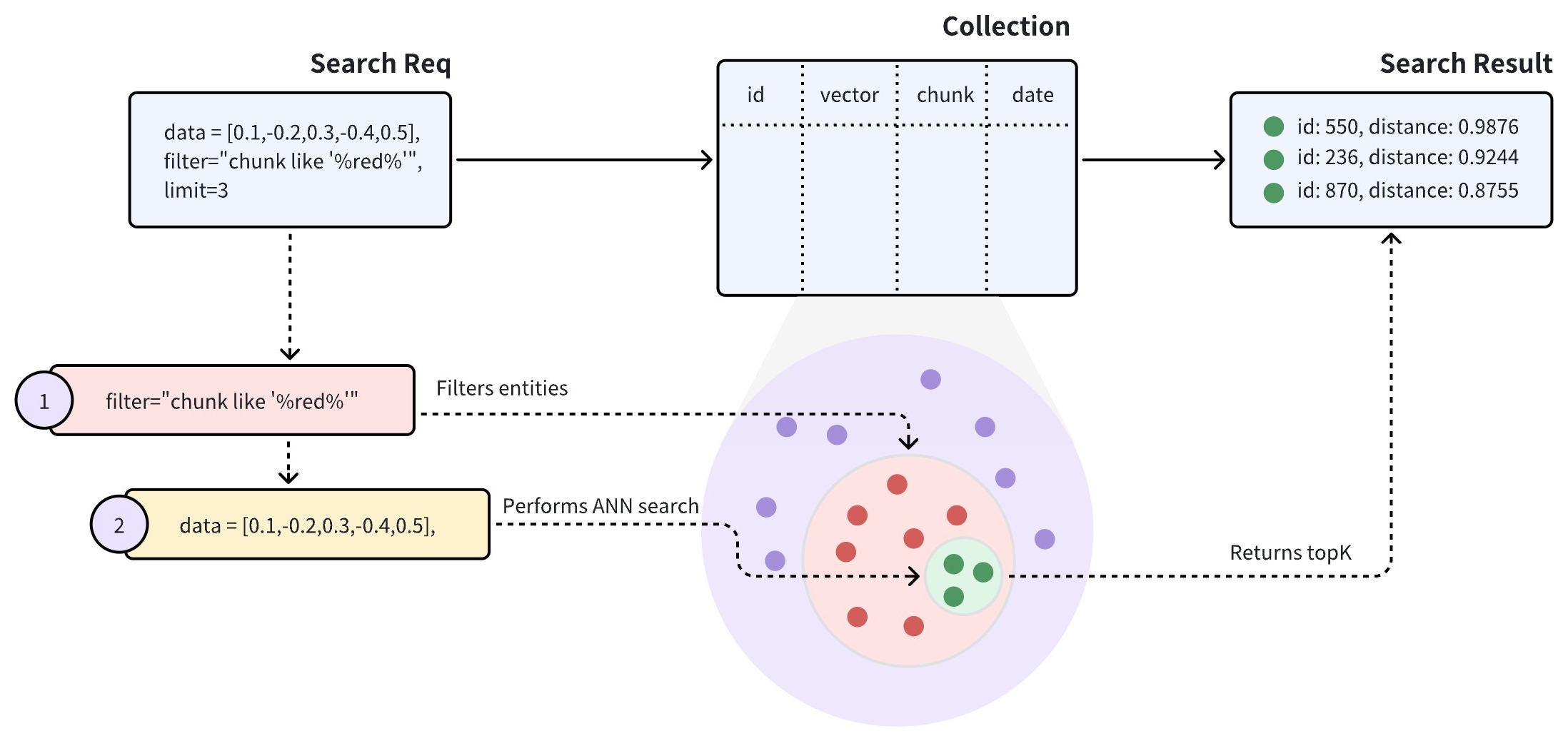
上の図に示すように、検索リクエストはフィルタ条件として chunk like "%red%" を持ち、これは Zilliz Cloud が chunk フィールドに red という語を含むすべてのエンティティを対象に ANN 検索を実行する必要があることを示しています。具体的には、Zilliz Cloud は次の処理を行います。
-
検索リクエストに含まれるフィルタ条件に一致するエンティティをフィルタリングします。
-
フィルタリングされたエンティティを対象に ANN 検索を実行します。
-
top-K 件のエンティティを返します。
反復フィルタリング
標準フィルタリングのプロセスは、検索範囲を効果的に小さな範囲に絞り込みます。ただし、フィルタ式が過度に複雑な場合、検索レイテンシが非常に高くなることがあります。そのような場合は、反復フィルタリングが代替手段となり、スカラーフィルタリングの負荷を軽減できます。
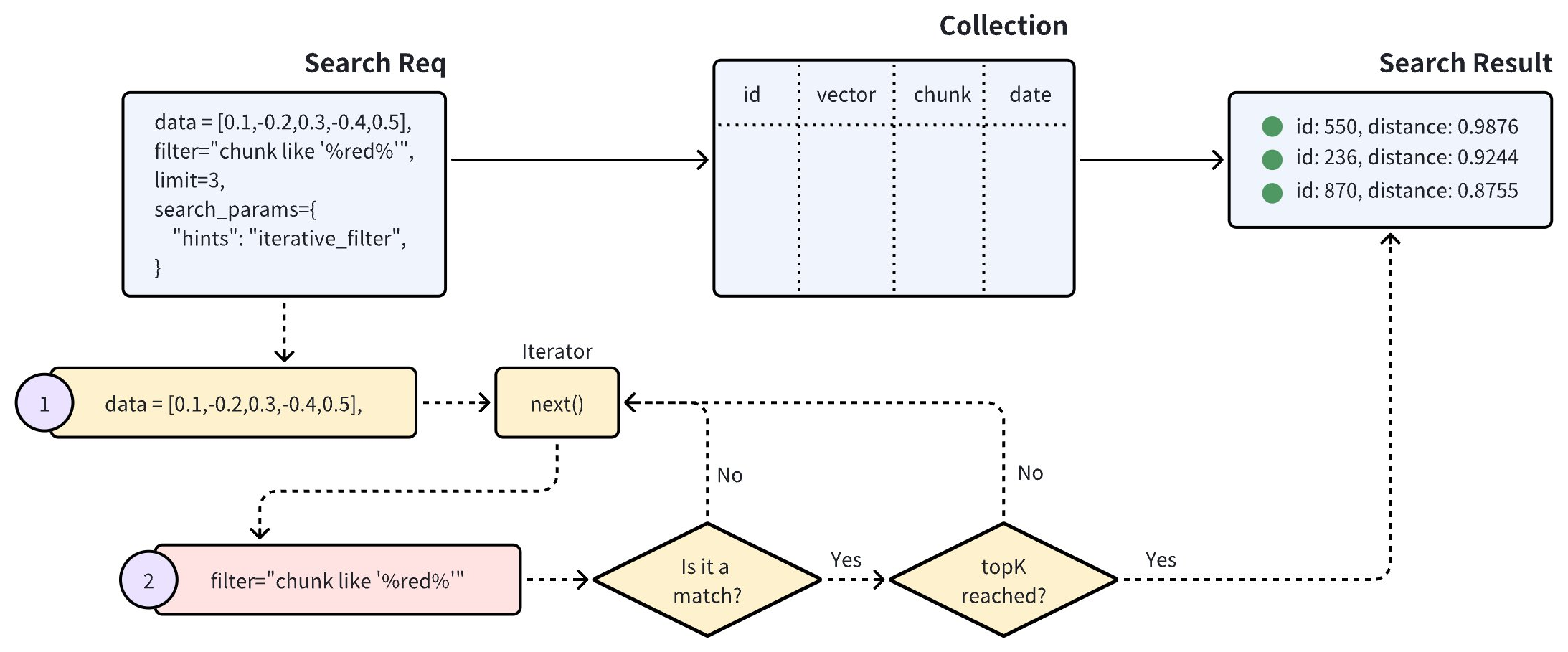
上の図に示すように、反復フィルタリングを使用した検索では、ベクトル検索を反復的に実行します。イテレーターから返される各エンティティはスカラーフィルタリングを受け、このプロセスは、指定された topK 件の結果が得られるまで継続されます。
この方法は、スカラーフィルタリングの対象となるエンティティの数を大幅に削減するため、非常に複雑なフィルタ式を扱う場合に特に有効です。
ただし、イテレーターがエンティティを 1 件ずつ処理する点に注意が必要です。この逐次的なアプローチは、特に多数のエンティティがスカラーフィルタリングの対象となる場合、処理時間の長期化やパフォーマンス上の問題につながる可能性があります。
例
このセクションでは、フィルタ付き検索を実行する方法を説明します。このセクションのコードスニペットは、コレクションに次のエンティティがすでに存在していることを前提としています。各エンティティには、id、ベクトル、color、likes の 4つのフィールドがあります。
[
    {"id": 0, "vector": [0.3580376395471989, -0.6023495712049978, 0.18414012509913835, -0.26286205330961354, 0.9029438446296592], "color": "pink_8682", "likes": 165},
    {"id": 1, "vector": [0.19886812562848388, 0.06023560599112088, 0.6976963061752597, 0.2614474506242501, 0.838729485096104], "color": "red_7025", "likes": 25},
    {"id": 2, "vector": [0.43742130801983836, -0.5597502546264526, 0.6457887650909682, 0.7894058910881185, 0.20785793220625592], "color": "orange_6781", "likes": 764},
    {"id": 3, "vector": [0.3172005263489739, 0.9719044792798428, -0.36981146090600725, -0.4860894583077995, 0.95791889146345], "color": "pink_9298", "likes": 234},
    {"id": 4, "vector": [0.4452349528804562, -0.8757026943054742, 0.8220779437047674, 0.46406290649483184, 0.30337481143159106], "color": "red_4794", "likes": 122},
    {"id": 5, "vector": [0.985825131989184, -0.8144651566660419, 0.6299267002202009, 0.1206906911183383, -0.1446277761879955], "color": "yellow_4222", "likes": 12},
    {"id": 6, "vector": [0.8371977790571115, -0.015764369584852833, -0.31062937026679327, -0.562666951622192, -0.8984947637863987], "color": "red_9392", "likes": 58},
    {"id": 7, "vector": [-0.33445148015177995, -0.2567135004164067, 0.8987539745369246, 0.9402995886420709, 0.5378064918413052], "color": "grey_8510", "likes": 775},
    {"id": 8, "vector": [0.39524717779832685, 0.4000257286739164, -0.5890507376891594, -0.8650502298996872, -0.6140360785406336], "color": "white_9381", "likes": 876},
    {"id": 9, "vector": [0.5718280481994695, 0.24070317428066512, -0.3737913482606834, -0.06726932177492717, -0.6980531615588608], "color": "purple_4976", "likes": 765}
]
クエリベクトルが対象のコレクションにすでに存在している場合は、検索前にそれらを取得する代わりに ids を使用することを検討してください。詳細については、Primary-Key Search を参照してください。
標準フィルタリングを使用した検索
以下のコードスニペットは、標準フィルタリングを使用した検索を示しています。次のコードスニペットのリクエストには、フィルタ条件といくつかの出力フィールドが含まれています。
- Python
- Java
- Go
- Rust
- C++
- NodeJS
- cURL
- Zilliz CLI
from pymilvus import MilvusClient

client = MilvusClient(
    uri="YOUR_CLUSTER_ENDPOINT",
    token="YOUR_CLUSTER_TOKEN"
)

query_vector = [0.3580376395471989, -0.6023495712049978, 0.18414012509913835, -0.26286205330961354, 0.9029438446296592]

res = client.search(
    collection_name="my_collection",
    data=[query_vector],
    limit=5,
    filter='color like "red%" and likes > 50',
    output_fields=["color", "likes"]
)

for hits in res:
    print("TopK results:")
    for hit in hits:
        print(hit)
import io.milvus.v2.client.ConnectConfig;
import io.milvus.v2.client.MilvusClientV2;
import io.milvus.v2.service.vector.request.SearchReq;
import io.milvus.v2.service.vector.request.data.FloatVec;
import io.milvus.v2.service.vector.response.SearchResp;
import java.util.*;

MilvusClientV2 client = new MilvusClientV2(ConnectConfig.builder()
        .uri("YOUR_CLUSTER_ENDPOINT")
        .token("YOUR_CLUSTER_TOKEN")
        .build());

FloatVec queryVector = new FloatVec(new float[]{0.3580376395471989f, -0.6023495712049978f, 0.18414012509913835f, -0.26286205330961354f, 0.9029438446296592f});
SearchReq searchReq = SearchReq.builder()
        .collectionName("my_collection")
        .data(Collections.singletonList(queryVector))
        .topK(5)
        .filter("color like \"red%\" and likes > 50")
        .outputFields(Arrays.asList("color", "likes"))
        .build();

SearchResp searchResp = client.search(searchReq);

List<List<SearchResp.SearchResult>> searchResults = searchResp.getSearchResults();
for (List<SearchResp.SearchResult> results : searchResults) {
    System.out.println("TopK results:");
    for (SearchResp.SearchResult result : results) {
        System.out.println(result);
    }
}

// Output
// TopK results:
// SearchResp.SearchResult(entity={color=red_4794, likes=122}, score=0.5975797, id=4)
// SearchResp.SearchResult(entity={color=red_9392, likes=58}, score=-0.24996188, id=6)
import (
    "context"
    "fmt"

    "github.com/milvus-io/milvus/client/v3/entity"
    "github.com/milvus-io/milvus/client/v3/milvusclient"
)

ctx, cancel := context.WithCancel(context.Background())
defer cancel()

milvusAddr := "YOUR_CLUSTER_ENDPOINT"
token := "YOUR_CLUSTER_TOKEN"

client, err := milvusclient.New(ctx, &milvusclient.ClientConfig{
    Address: milvusAddr,
    APIKey:  token,
})
if err != nil {
    fmt.Println(err.Error())
    // handle error
}
defer client.Close(ctx)

queryVector := []float32{0.3580376395471989, -0.6023495712049978, 0.18414012509913835, -0.26286205330961354, 0.9029438446296592}

resultSets, err := client.Search(ctx, milvusclient.NewSearchOption(
    "my_collection", // collectionName
    5,               // limit
    []entity.Vector{entity.FloatVector(queryVector)},
).WithConsistencyLevel(entity.ClStrong).
    WithANNSField("vector").
    WithFilter("color like 'red%' and likes > 50").
    WithOutputFields("color", "likes"))
if err != nil {
    fmt.Println(err.Error())
    // handle error
}

for _, resultSet := range resultSets {
    fmt.Println("IDs: ", resultSet.IDs.FieldData().GetScalars())
    fmt.Println("Scores: ", resultSet.Scores)
    fmt.Println("color: ", resultSet.GetColumn("color").FieldData().GetScalars())
    fmt.Println("likes: ", resultSet.GetColumn("likes").FieldData().GetScalars())
}
use milvus::v2::error::Result;
use milvus::v2::prelude::*;

#[tokio::main]
async fn main() -> Result<()> {
    let config = ConnectConfig::new().uri("YOUR_CLUSTER_ENDPOINT").token("YOUR_CLUSTER_TOKEN");
    let client = ClientV2::new(&config).await?;

    let query_vector = vec![0.3580376395471989f32, -0.6023495712049978, 0.18414012509913835, -0.26286205330961354, 0.9029438446296592];

    let res = client
        .search(
            SearchRequest::builder()
                .collection_name("my_collection")
                .vector_field("vector")
                .vectors(SearchVectors::Float(vec![query_vector]))
                .limit(5)
                .filter("color like \"red%\" and likes > 50")
                .output_fields(["color", "likes"])
                .build()?,
        )
        .await?;

    println!("{:?}", res.results());
    Ok(())
}
#include "milvus/MilvusClientV2.h"
#include <iostream>
#include <vector>

auto client = milvus::MilvusClientV2::Create();

milvus::ConnectParam connect_param{"YOUR_CLUSTER_ENDPOINT", "YOUR_CLUSTER_TOKEN"};
auto status = client->Connect(connect_param);
if (!status.IsOk()) {
    std::cout << status.Message() << std::endl;
}

std::vector<float> query_vector = {0.3580376395471989, -0.6023495712049978, 0.18414012509913835, -0.26286205330961354, 0.9029438446296592};
auto request = milvus::SearchRequest()
                   .WithCollectionName("my_collection")
                   .AddFloatVector(query_vector)
                   .WithLimit(5)
                   .WithAnnsField("vector")
                   .WithFilter(R"(color like "red%" and likes > 50)")
                   .AddOutputField("color")
                   .AddOutputField("likes");

milvus::SearchResponse response;
status = client->Search(request, response);
if (!status.IsOk()) {
    std::cout << status.Message() << std::endl;
}

for (auto& result : response.Results().Results()) {
    std::cout << "TopK results:" << std::endl;
    milvus::EntityRows output_rows;
    status = result.OutputRows(output_rows);
    for (const auto& row : output_rows) {
        std::cout << "\t" << row << std::endl;
    }
}
import { MilvusClient, DataType } from "@zilliz/milvus2-sdk-node";

const address = "YOUR_CLUSTER_ENDPOINT";
const token = "YOUR_CLUSTER_TOKEN";
const client = new MilvusClient({address, token});

const query_vector = [0.3580376395471989, -0.6023495712049978, 0.18414012509913835, -0.26286205330961354, 0.9029438446296592]

const res = await client.search({
    collection_name: "my_collection",
    data: [query_vector],
    limit: 5,
    filter: 'color like "red%" and likes > 50',
    output_fields: ["color", "likes"]
})
export CLUSTER_ENDPOINT="YOUR_CLUSTER_ENDPOINT"
export TOKEN="YOUR_CLUSTER_TOKEN"

curl --request POST \
--url "${CLUSTER_ENDPOINT}/v2/vectordb/entities/search" \
--header "Authorization: Bearer ${TOKEN}" \
--header "Content-Type: application/json" \
--header "Request-Timeout: 10" \
-d '{
    "collectionName": "my_collection",
    "data": [
        [0.3580376395471989, -0.6023495712049978, 0.18414012509913835, -0.26286205330961354, 0.9029438446296592]
    ],
    "annsField": "vector",
    "filter": "color like \"red%\" and likes > 50",
    "limit": 5,
    "outputFields": ["color", "likes"]
}'
# {"code":0,"cost":0,"data":[{"color":"red_4794","distance":0.5975796,"id":4,"likes":122},{"color":"red_9392","distance":-0.24996185,"id":6,"likes":58}],"topks":[2]}
# Zilliz CLI
# Prerequisite: run zilliz login and select your cluster with zilliz context set.
zilliz vector search \
  --collection my_collection \
  --body '{
  "data": [
    [
      0.3580376395471989,
      -0.6023495712049978,
      0.18414012509913835,
      -0.26286205330961354,
      0.9029438446296592
    ]
  ],
  "annsField": "vector",
  "filter": "color like \"red%\" and likes > 50",
  "limit": 5,
  "outputFields": [
    "color",
    "likes"
  ]
}' \
  --output json
検索リクエストに含まれるフィルタ条件は color like "red%" and likes > 50 です。これは and 演算子を使用して 2つの条件を指定しています。1つ目は、color フィールドの値が red で始まるエンティティを要求し、もう 1つは、likes フィールドの値が 50 より大きいエンティティを要求します。これらの要件を満たすエンティティは 2つだけです。top-K を 3 に設定すると、Zilliz Cloud はこれら 2つのエンティティとクエリベクトルとの距離を計算し、それらを検索結果として返します。
[
    {
        "id": 4,
        "distance": 0.3345786594834839,
        "entity": {
            "vector": [0.4452349528804562, -0.8757026943054742, 0.8220779437047674, 0.46406290649483184, 0.30337481143159106],
            "color": "red_4794",
            "likes": 122
        }
    },
    {
        "id": 6,
        "distance": 0.6638239834383389,
        "entity": {
            "vector": [0.8371977790571115, -0.015764369584852833, -0.31062937026679327, -0.562666951622192, -0.8984947637863987],
            "color": "red_9392",
            "likes": 58
        }
    },
]
メタデータフィルタリングで使用できる演算子の詳細については、Filtering Explained を参照してください。
反復フィルタリングを使用した検索
反復フィルタリングを使用してフィルタ付き検索を実行するには、次のようにします。
- Python
- Java
- Go
- Rust
- C++
- NodeJS
- cURL
- Zilliz CLI
from pymilvus import MilvusClient

client = MilvusClient(
    uri="YOUR_CLUSTER_ENDPOINT",
    token="YOUR_CLUSTER_TOKEN"
)

query_vector = [0.3580376395471989, -0.6023495712049978, 0.18414012509913835, -0.26286205330961354, 0.9029438446296592]

res = client.search(
    collection_name="my_collection",
    data=[query_vector],
    limit=5,
    filter='color like "red%" and likes > 50',
    output_fields=["color", "likes"],
    search_params={
        "hints": "iterative_filter"
    }
)

for hits in res:
    print("TopK results:")
    for hit in hits:
        print(hit)
import io.milvus.v2.client.ConnectConfig;
import io.milvus.v2.client.MilvusClientV2;
import io.milvus.v2.service.vector.request.SearchReq;
import io.milvus.v2.service.vector.request.data.FloatVec;
import io.milvus.v2.service.vector.response.SearchResp;
import java.util.*;

MilvusClientV2 client = new MilvusClientV2(ConnectConfig.builder()
        .uri("YOUR_CLUSTER_ENDPOINT")
        .token("YOUR_CLUSTER_TOKEN")
        .build());

FloatVec queryVector = new FloatVec(new float[]{0.3580376395471989f, -0.6023495712049978f, 0.18414012509913835f, -0.26286205330961354f, 0.9029438446296592f});
SearchReq searchReq = SearchReq.builder()
        .collectionName("my_collection")
        .data(Collections.singletonList(queryVector))
        .topK(5)
        .filter("color like \"red%\" and likes > 50")
        .outputFields(Arrays.asList("color", "likes"))
        .searchParams(new HashMap<String, Object>() {{
            put("hints", "iterative_filter");
        }})
        .build();

SearchResp searchResp = client.search(searchReq);

List<List<SearchResp.SearchResult>> searchResults = searchResp.getSearchResults();
for (List<SearchResp.SearchResult> results : searchResults) {
    System.out.println("TopK results:");
    for (SearchResp.SearchResult result : results) {
        System.out.println(result);
    }
}

// Output
// TopK results:
// SearchResp.SearchResult(entity={color=red_4794, likes=122}, score=0.5975797, id=4)
// SearchResp.SearchResult(entity={color=red_9392, likes=58}, score=-0.24996188, id=6)
import (
    "context"
    "fmt"

    "github.com/milvus-io/milvus/client/v3/entity"
    "github.com/milvus-io/milvus/client/v3/milvusclient"
)

ctx, cancel := context.WithCancel(context.Background())
defer cancel()

milvusAddr := "YOUR_CLUSTER_ENDPOINT"
token := "YOUR_CLUSTER_TOKEN"

client, err := milvusclient.New(ctx, &milvusclient.ClientConfig{
    Address: milvusAddr,
    APIKey:  token,
})
if err != nil {
    fmt.Println(err.Error())
    // handle error
}
defer client.Close(ctx)

queryVector := []float32{0.3580376395471989, -0.6023495712049978, 0.18414012509913835, -0.26286205330961354, 0.9029438446296592}

resultSets, err := client.Search(ctx, milvusclient.NewSearchOption(
    "my_collection", // collectionName
    5,               // limit
    []entity.Vector{entity.FloatVector(queryVector)},
).WithConsistencyLevel(entity.ClStrong).
    WithANNSField("vector").
    WithFilter("color like 'red%' and likes > 50").
    WithOutputFields("color", "likes").
    WithSearchParam("hints", "iterative_filter"))
if err != nil {
    fmt.Println(err.Error())
    // handle error
}

for _, resultSet := range resultSets {
    fmt.Println("IDs: ", resultSet.IDs.FieldData().GetScalars())
    fmt.Println("Scores: ", resultSet.Scores)
    fmt.Println("color: ", resultSet.GetColumn("color").FieldData().GetScalars())
    fmt.Println("likes: ", resultSet.GetColumn("likes").FieldData().GetScalars())
}
use milvus::v2::error::Result;
use milvus::v2::prelude::*;
use std::collections::HashMap;

#[tokio::main]
async fn main() -> Result<()> {
    let config = ConnectConfig::new().uri("YOUR_CLUSTER_ENDPOINT").token("YOUR_CLUSTER_TOKEN");
    let client = ClientV2::new(&config).await?;

    let query_vector = vec![0.3580376395471989f32, -0.6023495712049978, 0.18414012509913835, -0.26286205330961354, 0.9029438446296592];

    let res = client
        .search(
            SearchRequest::builder()
                .collection_name("my_collection")
                .vector_field("vector")
                .vectors(SearchVectors::Float(vec![query_vector]))
                .limit(5)
                .filter("color like \"red%\" and likes > 50")
                .output_fields(["color", "likes"])
                .extra_params(HashMap::from([("hints".into(), "iterative_filter".into())]))
                .build()?,
        )
        .await?;

    println!("{:?}", res.results());
    Ok(())
}
#include "milvus/MilvusClientV2.h"
#include <iostream>
#include <vector>

auto client = milvus::MilvusClientV2::Create();

milvus::ConnectParam connect_param{"YOUR_CLUSTER_ENDPOINT", "YOUR_CLUSTER_TOKEN"};
auto status = client->Connect(connect_param);
if (!status.IsOk()) {
    std::cout << status.Message() << std::endl;
}

std::vector<float> query_vector = {0.3580376395471989, -0.6023495712049978, 0.18414012509913835, -0.26286205330961354, 0.9029438446296592};
auto request = milvus::SearchRequest()
                   .WithCollectionName("my_collection")
                   .AddFloatVector(query_vector)
                   .WithLimit(5)
                   .WithAnnsField("vector")
                   .WithFilter(R"(color like "red%" and likes > 50)")
                   .AddExtraParam("hints", "iterative_filter")
                   .AddOutputField("color")
                   .AddOutputField("likes");

milvus::SearchResponse response;
status = client->Search(request, response);
if (!status.IsOk()) {
    std::cout << status.Message() << std::endl;
}

for (auto& result : response.Results().Results()) {
    std::cout << "TopK results:" << std::endl;
    milvus::EntityRows output_rows;
    status = result.OutputRows(output_rows);
    for (const auto& row : output_rows) {
        std::cout << "\t" << row << std::endl;
    }
}
import { MilvusClient, DataType } from "@zilliz/milvus2-sdk-node";

const address = "YOUR_CLUSTER_ENDPOINT";
const token = "YOUR_CLUSTER_TOKEN";
const client = new MilvusClient({address, token});

const query_vector = [0.3580376395471989, -0.6023495712049978, 0.18414012509913835, -0.26286205330961354, 0.9029438446296592]

const res = await client.search({
    collection_name: "my_collection",
    data: [query_vector],
    limit: 5,
    filter: 'color like "red%" and likes > 50',
    hints: "iterative_filter",
    output_fields: ["color", "likes"]
})
export CLUSTER_ENDPOINT="YOUR_CLUSTER_ENDPOINT"
export TOKEN="YOUR_CLUSTER_TOKEN"

curl --request POST \
--url "${CLUSTER_ENDPOINT}/v2/vectordb/entities/search" \
--header "Authorization: Bearer ${TOKEN}" \
--header "Content-Type: application/json" \
--header "Request-Timeout: 10" \
-d '{
    "collectionName": "my_collection",
    "data": [
        [0.3580376395471989, -0.6023495712049978, 0.18414012509913835, -0.26286205330961354, 0.9029438446296592]
    ],
    "annsField": "vector",
    "filter": "color like \"red%\" and likes > 50",
    "searchParams": {"hints": "iterative_filter"},
    "limit": 5,
    "outputFields": ["color", "likes"]
}'
# {"code":0,"cost":0,"data":[{"color":"red_4794","distance":0.5975796,"id":4,"likes":122},{"color":"red_9392","distance":-0.24996185,"id":6,"likes":58}],"topks":[2]}
# Zilliz CLI
# Prerequisite: run zilliz login and select your cluster with zilliz context set.
zilliz vector search \
  --collection my_collection \
  --body '{
  "data": [
    [
      0.3580376395471989,
      -0.6023495712049978,
      0.18414012509913835,
      -0.26286205330961354,
      0.9029438446296592
    ]
  ],
  "annsField": "vector",
  "filter": "color like \"red%\" and likes > 50",
  "limit": 5,
  "outputFields": [
    "color",
    "likes"
  ],
  "searchParams": {
    "hints": "iterative_filter"
  }
}' \
  --output json